Black National Anthem


February 12 …
“Lift Every Voice and Sing” — most often called the Black National Anthem — is a hymn that has long served as a spiritual, cultural, and political emblem for Black Americans.
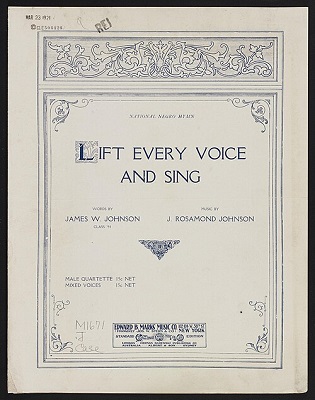
Originally written as a poem by James Weldon Johnson, it publicly debuted in celebration of Abraham Lincoln’s birthday on February 12, 1900 in a recital by a group of 500 children at the Stanton School in Jacksonville, FL, where James Weldon Johnson served as principal. His brother, J. Rosamond Johnson, would later set the poem to music.
The Johnson brothers would later publish their work in August of the same year. They then circulated the piece, which quickly gained popularity in Black churches, schools, and civic organizations.
In 1919, the National Association for the Advancement of Colored People (NAACP) formally adopted the song as its official anthem. This solidified its role as a rallying cry for civil rights and community unity.
The background and authorship of the song informed its purpose. James Weldon Johnson penned the lyrics as an ode to endurance, faith, and ambition during the post-Reconstruction and Jim Crow eras. John Rosamond Johnson composed the music, inspired by spirituals and hymns.
Early supporters included Black educators, church leaders, and civic groups who utilized the hymn to teach history, foster pride, and mobilize communities. The NAACP’s endorsement further elevated its national importance.
Throughout the 20th and 21st centuries, the song has served diverse musical and symbolic functions:
- As a unifying ritual during church services, school events, and political gatherings;
- As a protest anthem during the Civil Rights Movement; and most recently,
- After high-profile incidents of racial violence and national reckonings regarding policing and inequality, it has emerged as a powerful symbol of Black claims to dignity and justice.
Stakeholders have included Black community institutions and artists, as well as mainstream cultural and political organizations that have engaged with its public performance. The hymn has offered Black communities a shared language of collective memory, hope, and moral advocacy.
The implications of the Anthem are both cultural and political. It has preserved a narrative of struggle and resilience, influenced Black musical and liturgical traditions. And it contributed to the framing of demands for social justice, even as discussions continue on representation, official recognition, and the translation of symbolic affirmation into structural change.
The enduring power of the Black National Anthem lies in its ability to weave together poetic memory with a continued call for liberty and equality across generations.