

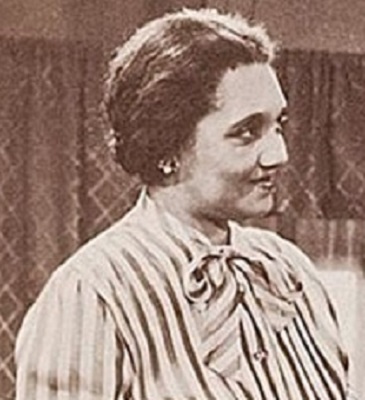
Alice B. Russell
June 30 …
Alice B. Russell was an actress, producer, and creative partner to pioneering filmmaker Oscar Micheaux whose work helped shape independent Black cinema and broaden representations of Black life on screen.
Born on June 30, 1889 in Maxton, NC, Russell — daughter of Robert Russell, a notable newspaper editor and political figure — grew up in a household rich in literacy and civic engagement, providing her with an exceptional cultural and intellectual foundation for a Black woman of her time. Although her formal education is not thoroughly documented beyond family and community schooling, her 1926 marriage license identifies her as a “concert soloist,” indicating a background in performance that evolved into film after her marriage to Micheaux that same year.
Russell’s main achievements are rooted in her extensive creative and production work with the Micheaux company. She acted in several films from the late silent era up to the 1940s, including titles like The Broken Violin, Wages of Sin, God’s Stepchildren, Birthright, and The Betrayal.
Russell also held producing credits for films such as Darktown Revue, Murder in Harlem, and Birthright, while also taking on various roles in on-set and distribution efforts — often credited as A. Burton Russell or “presenter.”
Russell’s contributions behind the camera were instrumental in allowing Micheaux to maintain an independent production-distribution circuit that offered alternative and dignified portrayals of Black characters and addressed social issues often overlooked by mainstream Hollywood. The Betrayal (1948) — the final Micheaux feature — premiered on Broadway, marking the end of a significant era in race filmmaking, a period in which Russell played a key role.
Russell’s influences and collaborators emerged from the Black literary, journalistic, and theatrical landscape of the early 20th century. Her father’s editorial work likely shaped her narrative inclinations and social awareness, while her relationship with Micheaux — both as a spouse and creative partner — provided a professional framework for her film endeavors.
Russell was part of a network of early Black — and women — filmmakers and creators focused on race films and cultural uplift. Actors from Micheaux’s repertory company, including Leroy Collins and Carman Newsome, acknowledged Russell’s editorial and supervisory contributions. Her contemporary African-American female filmmakers included Eloyce King Patrick Gist, Maria P. Williams, Tressie Souders, Madame E. Toussaint, and a slew of other creative businesswomen.
Despite receiving limited formal public recognition during her lifetime and much of her work remaining under-credited in mainstream film history, Russell’s contributions have gained increasing appreciation in modern scholarship and by film institutions. Film historians, the Women Film Pioneers Project, the American Film Institute, and contemporary retrospectives now regard her as a crucial collaborator in the creation of socially conscious, independent Black cinema.
The legacy of Alice B. Russell continues through the preservation of several Oscar Micheaux films that highlight her acting and production roles, as well as the growing acknowledgment of women of color who worked behind the scenes during Hollywood’s exclusionary years.
