

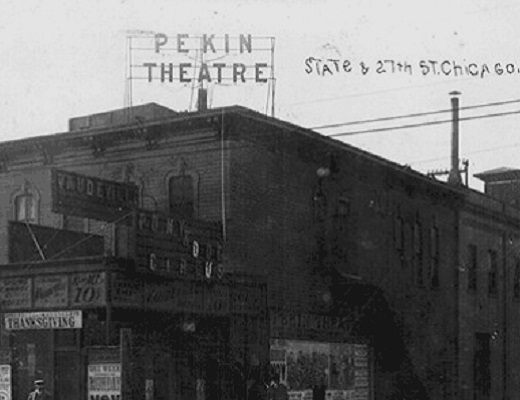
Pekin Theatre


June 18 …
The Pekin Theatre holds a special place in American entertainment history as one of the most important venues for African American theater during the early 20th century.
The Pekin became a cornerstone of Black culture in Chicago, offering a vital platform for African American performers and playwrights at a time when racial segregation severely restricted their opportunities in mainstream theaters. Its contributions to the arts were instrumental not only in shaping the evolution of Black theater but also in highlighting the social and political struggles of African Americans in an era of rapid change.
Saloon keeper Robert T. Motts established the Pekin on June 18, 1904 to provide entertainment to his community. A group of Black entrepreneurs — including notable figures like former vaudeville performer William C. “Billy” Howard and theater manager Charles Gilpin — subsequently aimed to evolve the venue into a place where African American artists could perform for Black audiences, while also introducing White audiences to the richness of Black talent and storytelling.
The Pekin quickly emerged as a cultural hub for Chicago’s Black community, attracting large crowds with its mix of dramatic plays, vaudeville acts, musical performances, and comedy shows. In a city where African Americans faced exclusion from mainstream venues, the Pekin provided a sense of community and a stage for artists to thrive, free from the constraints of racial discrimination.
Over the years, the Pekin became a significant cultural institution, presenting a diverse range of performances that tackled themes, such as racial inequality and African American identity. Its mission extended beyond entertainment — it sought to educate and inspire, giving voice to Black playwrights and actors who often lacked visibility elsewhere.
The Pekin hosted influential figures in Black entertainment, including legendary performers like Mamie Smith and emerging stars of the Harlem Renaissance. Through these performances, it played a crucial role in shaping the African American cultural movement, offering an environment where Black artists could hone their craft and confront the complexities of their social and political realities.
Though the Pekin closed its doors in 1939 due to economic challenges and shifting dynamics in the entertainment industry, its legacy continues to impact the landscape of Black theater in Chicago and beyond. The venue set the stage for future institutions, such as the Negro Ensemble Company and the Goodman Theatre, which embraced diversity in the arts.
Despite its relatively brief existence, the Pekin’s influence on the American entertainment industry and its role in shaping Black cultural expression are invaluable.
Today, the memory of the Pekin Theatre endures as a symbol of the resilience and creativity of African American artists during a pivotal moment in American history.
