
November 1 …
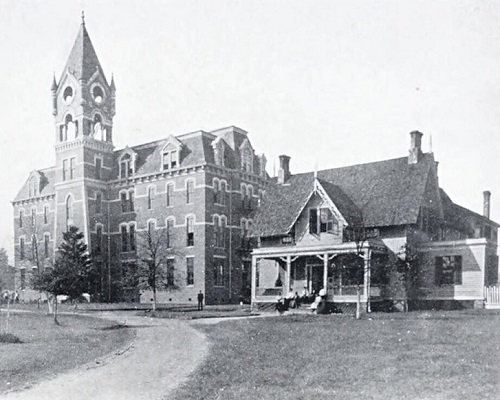
Paine College is a private, historically Black liberal arts institution founded on November 1, 1882 in Augusta, GA.
Originally established as Paine Institute, the school emerged during the Reconstruction era through a rare biracial partnership between the Colored (now Christian) Methodist Episcopal (CME) Church and the Methodist Episcopal Church, South. Its founding reflected a broader commitment to educating African Americans, particularly by preparing teachers, ministers, and community leaders for service across the post-Civil War South.
The idea for the institution originated with Bishop Lucius Henry Holsey of the CME Church, who, in 1869, advocated for a school to meet the educational and spiritual needs of newly emancipated people. With financial contributions from Black congregants — often in small amounts — and institutional support from white Methodist leaders, Paine Institute opened classes in January 1884 in rented facilities in downtown Augusta.
By 1886, the school had relocated to its present campus on Fifteenth Street. As its curriculum expanded beyond preparatory and industrial training, the institution formally became Paine College in 1903, the same year it awarded its first Bachelor of Arts degrees, marking its transition to a fully developed collegiate institution.
A defining feature of Paine’s early history was its interracial founding partnership. The CME Church, established in 1870 by formerly enslaved African Americans, provided leadership, vision, and a clear mission focused on Black advancement and self-determination.
The Methodist Episcopal Church, South, a predominantly white denomination, contributed financial resources, missionary networks, and administrative support. Although shaped by the era’s racial inequalities, the collaboration was a significant, pragmatic effort to expand educational opportunities for African Americans in the segregated South. Over time, the college became more closely aligned with the CME Church, though it continues to reflect the legacy of both traditions.
Throughout its history, Paine has remained committed to liberal arts education, moral development, and community service. Its academic programs have evolved to meet changing societal needs, with many students majoring in fields such as business administration, biology, sociology, criminal justice, and education. In its early decades, teacher education and religious studies were especially prominent, aligning closely with the institution’s founding purpose of producing educators and clergy for underserved communities.
Paine has produced many notable alumni who have made significant contributions to journalism, public service, science, and religion. Among them are:
- Louis Lomax (1942) — Pioneering journalist and television personality who helped bring African American perspectives to national media;
- Michael Thurmond (1975) — Prominent Georgia public official and historian;
- Dr. Shirley McBay (1954) — Mathematician who became the first African American dean of students at the Massachusetts Institute of Technology; and
- Bishop Woodie White (1958) — Influential leader in the United Methodist Church and an advocate for social justice.
Today, Paine College stands as a symbol of interracial cooperation and Black educational advancement in the post–Civil War United States. Its enduring mission continues to shape graduates committed to leadership, faith, and service, reinforcing its lasting significance in the broader history of historically Black colleges and universities.
Footnotes:
- Paine College. “History of Paine College.” Augusta, GA: Paine College. Accessed April 29, 2026.
- Georgia Historical Society. “Paine College Historical Marker.” Savannah, GA: Georgia Historical Society. Accessed April 29, 2026.
- Wikipedia contributors. “Paine College.” Wikipedia, The Free Encyclopedia. Last modified 2026. Accessed April 29, 2026.
- Paine College. “Alumni Spotlight.” Augusta, GA: Paine College. Accessed April 29, 2026.