

Order of the Eastern Star (Prince Hall Affiliated)
March 6 …
The Order of the Eastern Star (OES) — though founded in 1850 within white Masonic circles — became a significant institution in African American life through its later development within Prince Hall Freemasonry (a Black fraternal order founded on March 6, 1775).
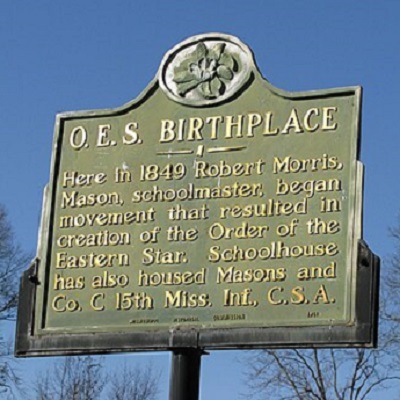
Created by Rob Morris as a fraternal auxiliary open to women related to Master Masons, OES initially reflected the racial exclusions of 19th-century American society. Because African American men were largely barred from mainstream Masonic lodges, Black women were likewise excluded from early Eastern Star chapters. This exclusion, however, led to the creation of parallel Eastern Star bodies within Prince Hall Masonry, where African Americans adapted the structure to serve their own communities.
The emergence of the Order of the Eastern Star (Prince Hall Affiliated) chapters occurred during the Reconstruction era, as Prince Hall lodges expanded across the United States. Rather than arising from a single founding convention, Black Eastern Star work developed gradually and locally.
The most credible early documentation points to Washington, DC, where Prince Hall–affiliated records indicate that organized Eastern Star activity was underway by November 1875, likely connected to the early formation of what would become the Eureka Grand Chapter. This date represents one of the earliest verifiable moments of institutional organization. However, it likely reflects the consolidation of several local chapters rather than the creation of a single first lodge.
At roughly the same time, other major urban centers with established Prince Hall Masonic networks appear to have developed Eastern Star chapters in parallel. Cities such as Philadelphia, New York, and Chicago — each with significant free Black populations and active Masonic lodges — likely saw the formation of similar chapters in the 1870s and 1880s. Although precise dates for these early chapters are less well documented, historians of Black fraternalism emphasize that this pattern of simultaneous, decentralized growth was typical of Prince Hall–affiliated institutions during Reconstruction and the post-Reconstruction period.
Within African American communities, the OES quickly became a vital institution for mutual aid, leadership, and social organization. Like Black churches and Masonic lodges, Eastern Star chapters offered women structured opportunities to engage in civic life, often serving as one of the few formal avenues for leadership.
The Order’s teachings — centered on the biblical heroines Adah, Ruth, Esther, Martha, and Electa — reinforced ideals of faith, fidelity, and service, while its organizational structure fostered skills in governance, public speaking, and philanthropy. Chapters sponsored educational initiatives, supported widows and orphans, and contributed to community welfare through organized charity.
During the late 19th and early 20th centuries, African American Eastern Star chapters expanded alongside the growth of Black urban communities. In cities such as Washington and Chicago, these chapters helped build large Masonic temples that served as hubs for fraternal meetings, cultural events, and political organizing, and also housed businesses, social organizations, and community gatherings. Through these institutions, Eastern Star members contributed to the development of a Black middle class and to broader efforts toward racial uplift.
By the early to mid-20th century, the African American Order of the Eastern Star had grown into a major force within Black associational life, with membership numbering in the hundreds of thousands. It provided leadership training for women who would go on to serve in churches, schools, and civic organizations, and it maintained connections to prominent figures in African American public life. Coretta Scott King, for example, was a member of Eastern Star, reflecting the organization’s ties to the modern Civil Rights Movement. Cultural figures such as Ella Fitzgerald and Aretha Franklin were also connected to Eastern Star networks, underscoring its broad social and cultural reach.
Like many fraternal organizations, the Order of the Eastern Star experienced a decline in membership in the late 20th century as patterns of civic engagement changed. Nevertheless, Prince Hall–affiliated Eastern Star chapters remain active in the twenty-first century, continuing their emphasis on charity, education, and community service.
Sources:
- Grimshaw, William H. Official History of Freemasonry Among the Colored People in North America. New York: Broadway Publishing, 1903.
- Dumenil, Lynn. Freemasonry and American Culture, 1880–1930. Princeton: Princeton University Press, 1984.
- Clawson, Mary Ann. Constructing Brotherhood: Class, Gender, and Fraternalism. Princeton: Princeton University Press, 1989.
