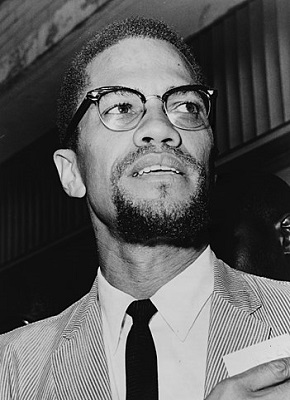
Malcolm X


May 19 …
Malcolm X — born Malcolm Little on May 19, 1925 in Omaha, NE — was one of the most powerful and transformative voices in the Civil Rights Movement.
Malcolm X’s early life was marked by hardship, with the violent death of his father, the institutionalized racism faced by his family, and the eventual disintegration of his home. These experiences shaped his worldview, pushing him toward a path of self-discovery and activism.
In his youth, Malcolm became involved in crime and was eventually incarcerated, where he began to study and convert to the Nation of Islam. This spiritual awakening and subsequent change in his life laid the foundation for his later work as an outspoken advocate for Black empowerment and civil rights.
As a leader within the Nation of Islam, Malcolm gained national attention for his fiery speeches and unapologetic stance on racial justice. He promoted Black pride, self-reliance, and a rejection of the oppressive systems that kept African Americans in a state of subjugation.
Malcolm X’s famous mantra, “By any means necessary,” encapsulated his belief in the right to fight for freedom and equality, even if it meant resorting to more radical measures. Unlike other civil rights leaders of his time, he was critical of nonviolence and integration, arguing instead for the creation of separate Black institutions that could support and uplift the African American community.
Malcolm X’s life took a dramatic turn after he left the Nation of Islam in 1964, following ideological differences and a transformative pilgrimage to Mecca. This journey broadened his perspective on race and religion, as he witnessed Muslims of all races coming together in unity. His new vision for racial justice became more inclusive, recognizing the importance of alliances across racial lines in the fight for global human rights.
Tragically, the life of Malcolm X was cut short when he was assassinated on February 21, 1965, just months after founding the Organization of Afro-American Unity. Despite his untimely death, his legacy as a symbol of resistance, empowerment, and self-determination continues to inspire generations in the ongoing struggle for racial justice