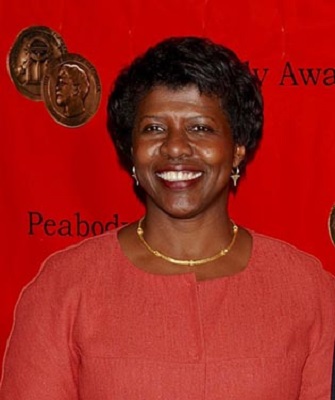
Gwen Ifill

September 29 …
Gwen Ifill was a trailblazing journalist whose integrity, insight, and pioneering presence helped reshape media and elevate the voices of those often left out of national conversations.
Born on September 29, 1955 in New York City to a Panamanian immigrant father who was an African Methodist Episcopal minister, Ifill grew up in a household grounded in faith, education, and civic responsibility. Her family moved frequently due to her father’s ministry, exposing her to a wide range of American communities and perspectives. These early experiences helped form her nuanced understanding of people and politics, laying the groundwork for her future as one of the most respected voices in journalism.
Ifill’s journalism career began in the 1970s when she graduated from Simmons College in Boston and entered a field where few women of color were represented. She initially worked at the Boston Herald-American, then moved on to prominent roles at The Baltimore Evening Sun, The Washington Post, and The New York Times.
Her reporting, particularly on political affairs, stood out for its depth and fairness, earning her the trust of readers and colleagues alike. She had an exceptional ability to translate complex political issues into accessible narratives without sacrificing nuance — a skill that made her stand out in an increasingly fast-paced media environment.
Ifill’s transition to television journalism marked a new chapter in both her career and the broader history of American media. She joined NBC News as a Capitol Hill correspondent, covering the inner workings of Congress with clarity and authority.
In 1999, Ifill broke new ground when she became the moderator of PBS’s “Washington Week in Review,” making her the first African American woman to host a major national political talk show. That same year, she also became a senior correspondent for “The NewsHour” with Jim Lehrer, later co-anchoring the show with Judy Woodruff — forming the first all-female anchor team in network news history.
Throughout her career, Ifill brought credibility and balance to the coverage of presidential elections, national conventions, and key policy debates. She moderated two vice-presidential debates — in 2004 and again in 2008 — approaching both with her trademark composure and incisiveness.
The 2008 debate, in particular, drew global attention, as it featured then-Senator Joe Biden and Alaska Governor Sarah Palin during a pivotal moment in U.S. political history. Ifill handled the event with professionalism, despite unwarranted criticism about her forthcoming book on Barack Obama. Her performance underscored her ability to remain impartial and focused amid public scrutiny.
Beyond her role as a journalist, Ifill became a cultural icon and mentor. She broke barriers quietly, without seeking the spotlight, yet her achievements inspired countless young journalists, especially women and people of color, to pursue careers in media.
Ifill frequently spoke about the importance of representation in newsrooms and the need for journalists to reflect the diversity of the communities they cover. Through both her work and her presence, she challenged traditional norms in journalism and helped broaden the scope of who gets to ask the questions and tell the stories that shape the national dialogue.
Ifill also wrote and published The Breakthrough: Politics and Race in the Age of Obama in 2009, a thoughtful examination of the changing political landscape for African Americans. The book contextualized Barack Obama’s rise within a broader movement of Black political leadership emerging across the country.
Drawing on decades of political reporting, Ifill offered insights into the intersection of race, power, and American democracy, deepening public understanding of a transformative period in U.S. history. Her writing was marked by the same clarity and humanity that characterized her broadcasts.
Ifill died in 2016 after a battle with cancer, leaving behind a profound legacy in journalism and public life. Her career was a testament to the power of perseverance, principle, and quiet excellence.
Through her reporting, moderating, and mentorship, Gwen Ifill elevated journalism at a time when public trust in media was eroding. She showed that it was possible to be tough yet fair, authoritative yet compassionate. In doing so, she not only chronicled American history — she helped shape it.
About The Photo:
Photo of Gwen Ifill at the 68th Annual George Foster Peabody Awards Luncheon held at the Waldorf-Astoria Hotel in New York in May 2009. (Photo credit: Anders Krusberg / Peabody Awards)