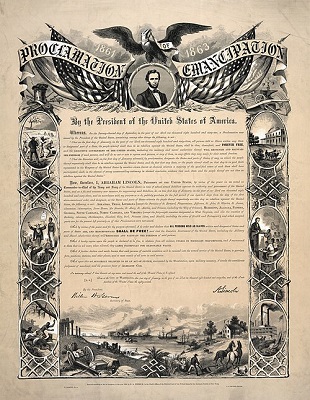
Emancipation Proclamation


September 22 …
The Emancipation Proclamation — officially Proclamation 95 — was a pivotal wartime decree that reshaped the moral and political meaning of the American Civil War and set the United States on a clearer path toward ending slavery.
Issued by Abraham Lincoln, the proclamation was initially announced in preliminary form on September 22, 1862, following the Union’s strategic success at Antietam, and officially took effect on January 1, 1863. It declared that all enslaved individuals in Confederate-held territories “shall be then, thenceforward, and forever free.”
Although it did not immediately liberate all enslaved people, as it only applied to rebelling states, it reframed the Union’s war effort into a fight for the abolition of slavery, in addition to preserving the nation. While Lincoln played a pivotal role, he was influenced by abolitionists like Frederick Douglass and the shifting political and military context of the American Civil War.
The roots of the proclamation lay in decades of intensifying conflict over slavery, characterized by compromises that temporarily balanced free and slave states and growing resistance from abolitionists.
By 1862, the war had reached a stalemate, and Lincoln was under pressure from various quarters — radicals calling for immediate abolition, border states cautioning against drastic measures, and military leaders seeking strategic advantages. Enslaved individuals themselves significantly contributed to the discourse by fleeing to Union lines, compelling military policy to address their plight.
The proclamation emerged as both a moral declaration and a strategic initiative aimed at weakening the Confederacy by dismantling its labor system. Key stakeholders included the Union government, Confederate states, enslaved African Americans, abolitionists, and foreign governments observing the conflict. The primary beneficiaries were enslaved individuals in Confederate territories, many of whom attained freedom as Union troops advanced.
The proclamation also paved the way for the enlistment of Black soldiers into the Union Army and Navy, resulting in nearly 180,000 African American men serving, which greatly enhanced the Union’s war effort. For Southern slaveholders, it posed a direct threat to their economic and social structures, while for Northern society, it signified a shift toward embracing emancipation as a national aim.
The repercussions of the proclamation were profound and enduring. It redefined the war’s purpose, dissuaded European powers from supporting the Confederacy, and laid the foundation for the eventual passage of the Thirteenth Amendment, which abolished slavery across the nation in 1865.
Historians widely regard the proclamation as one of the most significant executive actions in American history. It fundamentally transformed the nation’s trajectory regarding social justice, civil rights, and national identity.
The Emancipation Proclamation altered the legal status of more than 3.5 million enslaved African Americans in secessionist Confederate states from enslaved to free. Once these individuals escaped their enslavers — either by seeking refuge with Union forces or through the advance of federal troops — they were permanently liberated.