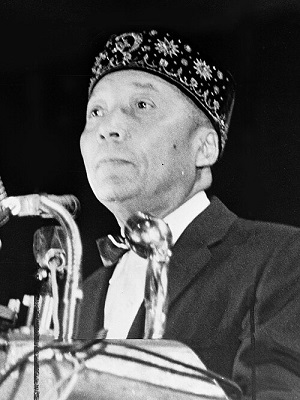
Elijah Muhammad

October 7 …
Elijah Muhammad was the long-time leader of the Nation of Islam whose teachings, organizational building, and political influence reshaped Black religious life, racial nationalism, and aspects of American public discourse in the mid-20th century.
Born Elijah Robert Poole on October 7, 1897 in Sandersville, GA, Muhammad left school after completing the fourth grade and initially worked in the rural South before moving to Detroit during the Great Migration in 1923. Although his formal education was limited, he honed his leadership and organizational skills through various job experiences, church activities, and immersion in the urban Black community, where he encountered Wallace D. Fard and the burgeoning movement that eventually became the Nation of Islam.
After Fard’s disappearance in the early 1930s, Muhammad took the helm of the Nation and transformed a small Detroit temple into a national organization by the 1950s and 1960s. He established a disciplined institutional framework that included temples, businesses, schools (such as Muhammad University of Islam), a newspaper (Muhammad Speaks), and programs that promoted economic self-help, moral reform, and separatist Black nationalism.
Muhammad’s leadership attracted tens of thousands of followers and shaped community institutions. That growth positioned the Nation of Islam as a significant force in urban Black life.
Muhammad’s theological and political influence drew from and reshaped various strands of Black religious thought and nationalist rhetoric. He taught a unique Nation of Islam doctrine that combined elements of Islam, Black nationalist cosmology, and social reform.
Additionally, he mentored and elevated notable figures, including Malcolm X (El-Hajj Malik El-Shabazz) and boxer Muhammad Ali. His movement later produced leaders such as Louis Farrakhan and, following his death, his son Warith Deen Mohammed, who guided most members toward mainstream Sunni Islam.
Muhammad’s contemporaries in the broader civil Rights Movement and Black Power Movement included Martin Luther King Jr. (with whom the Nation often had sharp disagreements) and Malcolm X (who initially was a protégé, but later became a critic). The debates between these figures and Muhammad significantly influenced the ideological landscape of the period.
Muhammad’s accolades were primarily political and communal rather than mainstream awards. His legacy is reflected in the Nation’s institutional achievements, the conversions and public prominence of disciples like Malcolm X and Muhammad Ali, and the movement’s enduring cultural impact — both controversial and formative — on American religion, race relations, and social organization.
Elijah Muhammad died on February 25, 1975. He left behind a complex legacy marked by empowerment, separatist doctrine, internal controversies — including legal issues and allegations regarding his personal conduct — and a lasting influence on Black religious and political life.