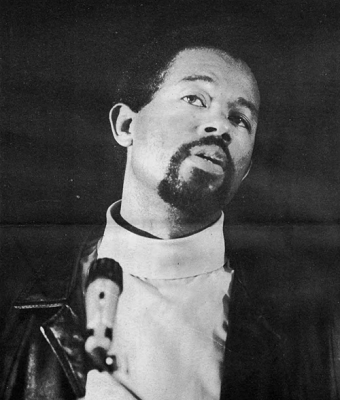
Eldridge Cleaver


August 31 …
Eldridge Cleaver was an American writer, political activist, and revolutionary thinker whose controversial but influential career placed him at the center of debates about race, power, and justice during the turbulent decades of the 1960s and 1970s.
Born on August 31, 1935 in Wabbaseka, AR, Cleaver was raised in a family that later relocated to Los Angeles, where he became acutely aware of social inequalities that would shape his political beliefs. His youth was defined by interactions with the criminal justice system, leading to significant prison time in the 1950s and early 1960s.
While incarcerated in facilities like Folsom State Prison, he immersed himself in extensive reading of philosophy, politics, and literature, engaging deeply with the works of thinkers such as Malcolm X, whose critiques of racial oppression resonated profoundly with him. During this time, Cleaver honed his writing skills through essays and reflections that explored themes of race, identity, and American society, effectively educating himself through rigorous intellectual exploration.
Upon his release from prison, Cleaver quickly rose to prominence within the radical political movements of the late 1960s. He joined the Black Panther Party, where he became its Minister of Information, using journalism and political commentary to articulate the group’s ideology and confront systemic racism in the United States. He also served as editor of the official Panthers’ publication, The Black Panther newspaper.
His 1968 book, Soul on Ice, a collection of essays largely penned during his incarceration, became a significant and controversial work, analyzing race relations, revolutionary politics, and personal transformation. Cleaver’s activism positioned him alongside other notable figures of the time, including Black Panther Party founders Huey P. Newton and Bobby Seale, as well as civil rights leaders like Martin Luther King Jr. and Stokely Carmichael, despite their differing strategies and philosophies.
Cleaver’s life was marked by dramatic shifts, including a period of exile in Algeria and France due to legal issues in the United States. Over time, his political views evolved, and he returned to the U.S. in the 1970s, exploring various forms of political engagement and public discourse.
Although he did not receive formal recognition for his activism, Cleaver continued to be a significant voice in the conversation surrounding race, revolution, and American political culture.
Through his writings, speeches, and involvement in political matters, Eldridge Cleaver left a complex and lasting legacy as a provocative figure in the history of American social movements and radical political thought.