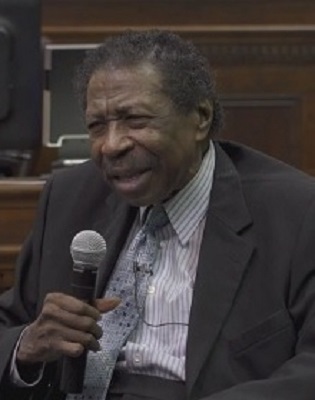
Bruce Boynton

June 19 …
Sometimes called “the original Freedom Rider,” Bruce Boynton was a pivotal figure in American civil rights history known for his courageous challenge against racial segregation in the 1960s.
As a pivotal figure in the legal struggles that dismantled discriminatory practices in public accommodations, Boynton’s actions and legal initiatives significantly contributed to the broader Civil Rights Movement and the pursuit of equality in the United States.
Born on June 19, 1937 in Selma, AL, Boynton grew up in a racially segregated South, an upbringing that profoundly shaped his understanding of justice and equality. He attended the historically Black Alabama State University, where experiences in the segregated South ignited his passion for civil rights.
Boynton later pursued a law degree at Howard University School of Law, learning from some of the most influential figures in African American legal thought, such as Charles Hamilton Houston and Thurgood Marshall. This strong educational foundation would later inform his legal strategies and equip him for the larger fight for civil rights.
Boynton’s most significant contribution to the Civil Rights Movement occurred in 1958 when he was arrested for sitting in the “whites-only” section of a bus terminal restaurant in Richmond, VA. At that time, segregation was widespread in public spaces, especially in the South. As a law student traveling from Washington, DC to Alabama, Boynton inspired the Freedom Riders movement when he bravely refused to adhere to the segregation policies of the bus terminal.
Boynton’s arrest sparked a legal battle that culminated in the landmark 1960 Supreme Court case, Boynton v. Virginia. The Court’s ruling in Boynton’s favor declared segregation in interstate bus terminals unconstitutional, marking a crucial victory that propelled the Civil Rights Movement forward by challenging the entrenched system of segregation in public facilities.
Throughout his career, Boynton was deeply influenced by prominent civil rights leaders, such as Martin Luther King Jr. and Thurgood Marshall, who significantly impacted his legal strategies and activism. His contemporaries, including legal minds from the NAACP Legal Defense Fund, provided invaluable mentorship and support as he fought for justice.
Boynton’s work, particularly in Boynton v. Virginia, established an important legal precedent for future civil rights battles. His commitment to racial equality and advocacy for the enforcement of federal desegregation laws set a standard for fellow activists and lawyers.
Though he did not seek personal recognition, Boynton’s contributions were crucial to the legal triumphs that followed, including the Freedom Rides and the Civil Rights Act of 1964
Historians and civil rights organizations have acknowledged the role of Bruce Boynton in the movement, recognizing how his courage in opposing segregation in public spaces was instrumental in dismantling institutionalized racism in America.