

Breonna Taylor

June 5 …
Breonna Taylor was a 26-year-old emergency medical worker whose life and death became a defining catalyst for modern debates about race, policing, and justice in the United States.
Born on June 5, 1993 in Grand Rapids, MI, Taylor was primarily raised by her mother in a family connected to healthcare, ultimately relocating to Louisville, KY, where she established her adult life and relationships. Known for her compassion and determination, friends and family recognized her as someone who embraced responsibility at an early age, valuing stability, independence, and care for others.
Taylor’s personal journey reflected common aspirations. This included building a career, securing her finances, and planning for a future that included home ownership and further education.
After high school, Taylor pursued education, briefly attending the University of Kentucky before returning to Louisville to concentrate on her work and practical goals. She became an emergency medical technician and later an emergency room technician, making direct contributions to patient care.
By 2020, she was working in healthcare during the COVID-19 pandemic as an essential worker on the front lines. With aspirations to further her education and train as a nurse, she showcased a long-term commitment to public service and the medical field.
Taylor’s accomplishments were largely rooted in everyday impact rather than public recognition — offering emergency care, supporting her community, and charting a path of upward mobility through healthcare work. Those who knew her described her as motivated and caring, effectively balancing her professional duties with strong family ties. Generally, her life encapsulated the experiences of many young Black Americans striving for stability and professional development within systems that often present structural challenges.
On March 13, 2020, Taylor was tragically killed in her Louisville apartment when police officers forcibly entered during a late-night raid linked to a drug investigation involving another individual. Unarmed at the time, no drugs were found in her home. During the incident, her boyfriend fired a shot, thinking intruders had invaded, prompting officers to return fire, ultimately striking and killing her.
The aftermath led to widespread public outrage, a $12 million settlement for Taylor’s family, policy changes limiting “no-knock” warrants, and a complex legal process in which some officers faced federal civil rights charges. One officer was ultimately convicted and sentenced to prison, while others had charges dismissed or contested over time.
Taylor’s death became a pivotal rallying point in the broader movement for racial justice, joining other high-profile cases from 2020. Her name was invoked in protests, cultural discussions, and policy debates, raising awareness around police practices and the unique experiences of Black women.
The phrase “Say Her Name” gained prominence as part of her legacy, highlighting the need for visibility and accountability. To highlight social justice and the Black Lives Matter movement, the abbreviated and postponed 2020 WNBA season was dedicated to Taylor and other Black women who were either killed by police or whose deaths resulted from over-policing, such as Sandra Bland.
The life and death of Breonna Taylor significantly influenced social justice movements, contributed to legislative reforms, and reshaped national conversations about policing, civil rights, and systemic inequality — impacts that continue to resonate in public discourse and policy debates today.
About The Photo:
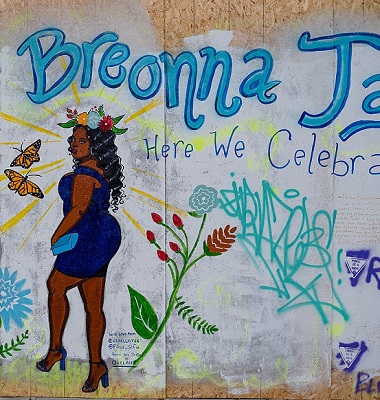
- Starting in the Summer of 2020, professional and amateur artists created murals all over the world, including this one in Oakland, California. Mural by Estella Tse and Sofía Sharpe / Photograph by Levi Clancy.
