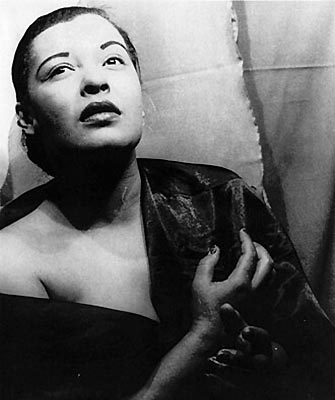
Billie Holiday
April 7 …
Trouble in the life of Billie Holiday began on April 7, 1915 — a few reports say 1912 — in Baltimore, when she was born Eleanora Fagan Gough.
Holiday’s father, Clarence Holiday, was a teenaged jazz guitarist and banjo player who later played in the orchestra of Fletcher Henderson. He never married her mother, Sadie Fagan, and left them shortly after her birth.
Holiday was sent to a Catholic reform school at the age of 10, reportedly after she admitted being raped. Though sentenced to stay until adulthood, a family friend secured her released after two years. With her mother, she moved in 1927, first to New Jersey, then to Brooklyn.
Surviving through domestic work, and occasionally prostitution, Billie’s big singing break came in 1933 when a laughable dancing audition at a speakeasy prompted her accompanist to ask if she could sing. In fact, by that time Holiday had likely been singing at various NYC clubs as early as 1930-31.
Whatever her singing origins, she first gained public notoriety in early 1933, when record producer John Hammond — only three years older than Holiday herself and just beginning his career — wrote her up in a column for Melody Maker and brought Benny Goodman to one of her performances. She made her commercial debut with Goodman’s small band shortly thereafter at Columbia Studies on November 27, 1933, with “Your Mother’s Son-In-Law.”
In early 1935 she made her first appearance at the Apollo Theater, and her film debut in a one-reeler with Duke Ellington. Later that year she finally entered the studio and recorded four sessions.
The collaboration of Holiday with Teddy Wilson produced the hit “What a Little Moonlight Can Do,” which became a jazz standard. Throughout the 1930s and 1940s, she had mainstream success on labels such as Columbia and Decca. By the late 1940s, however, she was beset with legal troubles and drug abuse. After a short prison sentence, she performed a sold-out concert at Carnegie Hall.
Holiday was a successful concert performer throughout the 1950s, with two further sold-out shows at Carnegie Hall. Because of personal struggles and an altered voice, her final recordings were met with mixed reaction, though mildly successful. Her final album, Lady In Satin, was released in 1958.

Portrait of Holiday and Mister, Downbeat, New York, N.Y., ca. Feb. 1947 (photo to William P. Gottlieb)
Billie Holiday died of heart failure on July 17, 1959, at age 44.
In the book The NPR Curious Listener’s Guide to Jazz, jazz historian Loren Schoenberg asserted that “no one would dispute that Billie Holiday is the definitive Jazz Singer.”
Footnotes:
- Spotify’s biography page “Billie Holiday.” Retrieved April 25, 2025.
- Wikipedia Contributors. “Billie Holiday.” Wikipedia: The Free Encyclopedia. Wikipedia, The Free Encyclopedia, 25 April 2025. Web. 25 April 2025. https://en.wikipedia.org/wiki/Billie_Holiday#cite_note-:0-117
- Schoenberg, Loren (2002). The NPR Curious Listener’s Guide to Jazz. Perigee Books. 118. ISBN 978-0-399-52794-4. Retrieved October 12, 2024.