

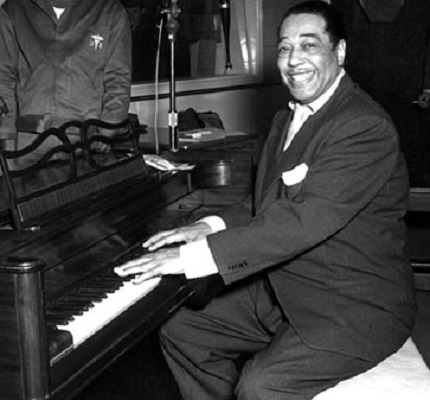
Duke Ellington
April 29 …
Duke Ellington was one of the most influential figures in American music.
Born Edward Kennedy Ellington on April 29, 1899 in Washington, DC and raised in a middle-class African American family, he began piano lessons at the age of seven and showed a remarkable aptitude for music early on. By his teenage years, he was already composing and performing professionally. His move to New York City during the Harlem Renaissance placed him at the heart of a cultural explosion that would shape the course of American arts and letters for decades to come.
Ellington’s most notable contributions came through his extraordinary work as a bandleader and composer. Leading his orchestra from 1923 until his death in 1974, he transformed the big band from a dance ensemble into a powerful vehicle for sophisticated musical expression. Unlike many of his contemporaries, Ellington wrote music specifically for the unique talents of his musicians, such as Johnny Hodges, Cootie Williams, and Harry Carney, creating a sound that was both personalized and universally resonant. His compositions ranged from short swing numbers to extended suites and sacred concerts, showcasing an unparalleled range and complexity.
A prolific composer, Ellington wrote over a thousand pieces during his lifetime. Iconic songs like “Mood Indigo,” “It Don’t Mean a Thing (If It Ain’t Got That Swing),” “Satin Doll,” and “Take the ‘A’ Train” (written by his collaborator Billy Strayhorn) became anthems of the American jazz idiom. But Ellington’s work went far beyond entertainment — his music served as a form of cultural commentary and identity. Through suites like Black, Brown, and Beige and The Deep South Suite, he addressed themes of African American history, social injustice, and spiritual resilience, embedding meaning within the music.
Ellington was also a pioneer in blurring the lines between genres. While he is primarily remembered as a jazz musician, his work encompassed elements of classical, gospel, blues, and world music. His musical ambition led him to collaborate with greats across genres and backgrounds, including Ella Fitzgerald, Mahalia Jackson, and even classical orchestras. In doing so, he elevated jazz to a respected art form, deserving of critical and academic recognition, and paved the way for future generations of genre-defying artists.
Beyond his musical genius, Ellington’s persona was equally influential. He carried himself with elegance and dignity, often referring to himself as “beyond category”—a statement not just about his music but about breaking racial and cultural boundaries. In an era marked by segregation and limited opportunities for Black artists, Ellington’s international acclaim served as a source of pride and empowerment for the African American community. His tours abroad, especially through the State Department-sponsored “jazz diplomacy” tours, positioned him as a cultural ambassador for the United States.
Ellington’s influence on American history is profound. He redefined the possibilities of Black artistic achievement and helped shape the narrative of African American contributions to the nation’s cultural fabric. His ability to articulate the complexities of Black life through sound helped bring African American experiences into the broader American consciousness. He was honored with numerous awards during his lifetime, including the Presidential Medal of Freedom in 1969 and a posthumous Pulitzer Prize in 1999.
Today, the legacy of Duke Ellington endures as a towering figure in not only jazz but in American cultural history. His music continues to be studied, performed, and celebrated around the world. Through his innovative compositions, powerful storytelling, and lifelong commitment to excellence, Ellington not only entertained but educated and inspired generations. He proved that music could be a vehicle for change and understanding, leaving behind a body of work that continues to speak to the soul of America.
