

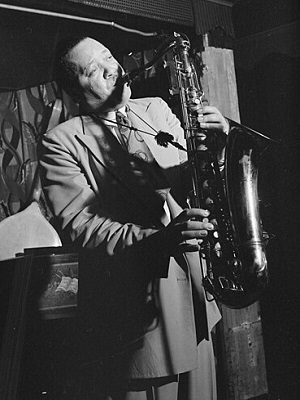
Lester Young
August 27 …
Lester Young was a seminal tenor saxophonist whose relaxed, lyrical tone and conversational phrasing reshaped jazz improvisation and left a lasting mark on American music, culture, and performance.
Born on August 27, 1909 in Woodville, MS, Young was raised in a musical family that toured regionally, where the Young Family Band introduced him to a variety of instruments at an early age. By the early 1930s, he had settled in Kansas City, immersing himself in the vibrant music scene and working with local bands, which honed his vocal abilities. Though his formal education was limited, the practical experience he gained from traveling bands and orchestras became his main source of musical training.
Young gained national fame as a featured soloist with the Count Basie orchestra from the mid-1930s to 1940. His recordings from this period, along with his later small-group performances and collaborations with Billie Holiday, established a new tenor ideal characterized by a relaxed, light tone, flexible rhythm, and melodic economy.
Young introduced repertoire and solo techniques, such as “Lester Leaps In,” “Taxi War Dance,” and intimate accompaniments for Billie Holiday, which became standards in jazz. His innovative style foreshadowed cool jazz and impacted melodic and harmonic approaches across various genres.
Despite personal challenges — including military service, health issues, and struggles with alcohol — his creative legacy remained intact until his passing in New York on March 15, 1959.
Young’s influences and mentors included early New Orleans and big-band legends like Louis Armstrong and Frankie Trumbauer. He developed alongside contemporaries and collaborators, such as Count Basie, Billie Holiday, who affectionately called him “Pres” or “Prez,” Buck Clayton, and Herschel Evans, as well as members of Basie’s small groups.
Young was often compared to fellow tenor giants Coleman Hawkins and Ben Webster. His direct stylistic proteges included Stan Getz, Zoot Sims, Al Cohn, Paul Quinichette (nicknamed “Vice-Prez”), and Lee Konitz, as well as an entire generation of musicians shaped by his influence, such as Charlie Parker, John Coltrane, and Sonny Rollins.
Culturally and historically, Young transformed the sound of the tenor saxophone. His cool, understated expressiveness reshaped American concepts of musical “hipness,” diction, and phrasing, popularizing much of the hipster vernacular associated with jazz culture.
Young played a significant role in shifting jazz from mere dance-hall entertainment toward a more personal, narrative art form. His recordings with Basie and Holiday remain pivotal in the American songbook, and his stylistic innovations laid the groundwork for the West Coast cool movement, influenced bebop’s melodic development, and later modern jazz progression.
Although he received limited formal recognition during his lifetime, Young’s posthumous acclaim has been substantial. He is widely celebrated in jazz history, inducted into jazz halls of fame, and acknowledged in retrospectives and scholarship.
Critics, musicians, and institutions consistently regard Lester Young as one of the most influential tenor saxophonists of the 20th century, with his nickname “Pres/Prez” enduring as a cultural symbol of his artistic legacy.
