
October 3 …
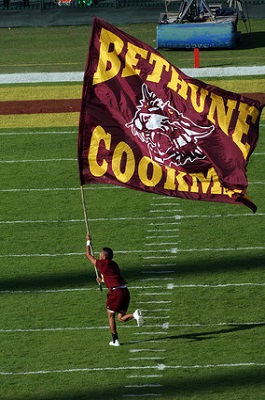
Bethune-Cookman University (B–CU or Bethune–Cookman) — a private Historically Black University located in Daytona Beach, FL — traces its origins to October 3, 1904, when educator and civil rights leader Mary McLeod Bethune founded the Daytona Educational and Industrial Training School for Negro Girls.
Beginning with just a handful of students in a small rented house, Bethune emphasized literacy, vocational skills, and moral education, reflecting her belief in education as the foundation for racial uplift and self-sufficiency. Early financial support came from local Black communities as well as white philanthropists, including James Gamble of Procter & Gamble.
In 1923, the school merged with the Cookman Institute for Boys in Jacksonville, a Methodist Episcopal institution founded in 1872, forming Bethune-Cookman Collegiate Institute. This merger expanded academic offerings and resources, and by 1943 the institution was authorized to grant four-year degrees, becoming Bethune-Cookman College.
Its curriculum evolved from industrial and teacher training programs into a broader liberal arts education, eventually incorporating programs in business, education, nursing, and the sciences. The institution later achieved university status in 2007, reflecting its growth in graduate education and expanded academic scope.
Bethune-Cookman has played a significant role in African American higher education, particularly in Florida and the broader South. It has maintained strong ties to the United Methodist Church, which has provided governance and financial support. The university has also benefited from philanthropic contributions and federal support, particularly during the 20th century, which enabled campus expansion and program development.
Bethune Cookman is regularly recognized among historically Black colleges and universities by U.S. News & World Report and other ranking organizations.
The university’s alumni have made important contributions in politics, music, sports, and public service. Among its notable graduates are the following individuals who reflect the institution’s longstanding commitment to leadership and community impact.
- Harry T. Moore (attended Cookman Institute) — Pioneering civil rights activist in Florida.
- Rickey Smiley (1992) — Nationally known entertainer.
- Eartha M.M. White — Civic leader and philanthropist.
Today, Bethune-Cookman University continues to uphold the vision that Mary McLeod Bethune held of education as a tool for empowerment. Its legacy is rooted in resilience, faith, and service — and it remains an important institution in the history of African American education.
Footnotes:
- Encyclopaedia Britannica, “Bethune-Cookman University,” Encyclopaedia Britannica Online, last modified 2023.
- Bethune-Cookman University, “Our History,” Official Website, accessed April 18, 2026.
- Bobby L. Lovett, America’s Historically Black Colleges & Universities: A Narrative History, 1837–2009 (Macon, GA: Mercer University Press, 2011).