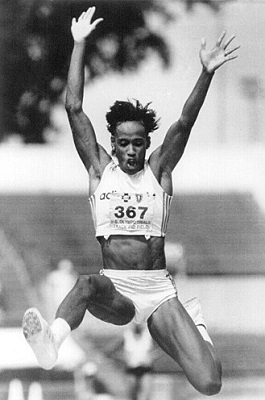
Jackie Joyner-Kersee

March 3 …
Jackie Joyner-Kersee is widely considered one of the greatest athletes in American history, particularly known for her extraordinary accomplishments in track and field, where she dominated the heptathlon and long jump events. Her groundbreaking success not only elevated her to the top of her sport but also made her a symbol of perseverance and excellence for generations of athletes, particularly women of color.
Born on March 3, 1962 in East St. Louis, IL, Joyner-Kersee emerged from a challenging background, yet her exceptional athletic talent was evident from a young age. She attended the University of California, Los Angeles (UCLA), excelling in track and field across multiple events, quickly drawing attention for her remarkable potential.
With the guidance of coach Bob Kersee, Joyner-Kersee honed her skills and became a standout in the heptathlon and long jump. Her rapid ascent from promising collegiate athlete to Olympic contender was marked by determination and ambition, culminating in her Olympic debut in 1984, where she had already made a significant impact in American track and field.
Joyner-Kersee’s achievements on the global stage are nothing short of legendary. She secured three Olympic gold medals (in 1988 and 1992), along with one silver and two bronze medals, solidifying her status as one of the most decorated athletes in Olympic history. Her performance at the 1988 Seoul Olympics, where she claimed gold in both the heptathlon and long jump, is often hailed as one of the greatest accomplishments in track and field.
In addition to her medals, she set world records in both events, establishing herself as one of the sport’s all-time greats. Her success stemmed not only from her physical prowess, but also her mental resilience, as she overcame injuries and setbacks to consistently excel.
Throughout her career, Joyner-Kersee found inspiration from various figures, both within and outside athletics. Her coach and husband, Bob Kersee, played a pivotal role in developing her technique and competitive outlook. She looked up to athletes like Florence Griffith Joyner, whose flair and achievements motivated her in her youth, as well as Wilma Rudolph, who paved the way for women of color in Olympic sports.
Joyner-Kersee’s peers, including Gwen Torrence and Marion Jones, shared her commitment to excellence, raising the bar for women’s athletics. As a mentor, she dedicated herself to guiding younger athletes through the complexities of elite sports, while also addressing personal challenges. Her influence has persisted beyond her Olympic journey, inspiring athletes such as Allyson Felix and Sanya Richards-Ross, who often acknowledge her as a role model.
Throughout her distinguished career, Joyner-Kersee received numerous honors, including the Associated Press Female Athlete of the Year, the Jesse Owens Award, and induction into the U.S. Track & Field Hall of Fame. She has also received multiple honorary doctorates for her contributions to both sports and philanthropy.
Joyner-Kersee’s influence transcends athletics, as she has leveraged her platform to advocate for at-risk youth and promote educational opportunities, especially for young women of color. She founded the Jackie Joyner-Kersee Foundation, which aims to empower underserved communities through initiatives in sports, education, and health.
The legacy of Jackie Joyner-Kersee as one of the most iconic athletes in American history, along with her ongoing commitment to social justice and community development, has made her a transformative figure both in the realm of sports and society as a whole.