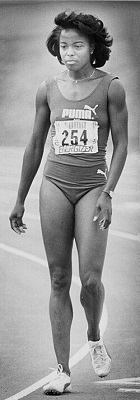
Evelyn Ashford

April 15 …
Evelyn Ashford is widely regarded as one of the greatest American sprinters of all time, making a lasting impact on the sport of track and field, particularly in the 100 meters and 4×100 meter relay. Her outstanding career, which spanned over a decade, set new standards of excellence and paved the way for future generations of athletes, especially African American women in track and field.
Born on April 15, 1957 in Shreveport, LA, Ashford grew up in Los Angeles, quickly establishing herself as a remarkable athlete. She attended UCLA, where she gained recognition as one of the top sprinters in collegiate track and field.
Under the mentorship of coaches like Bob Kersee — who later guided several renowned athletes including Jackie Joyner-Kersee — Ashford honed her skills and laid the groundwork for her future successes. Her achievements in college were just the beginning, as she went on to capture multiple national championships and set numerous records, solidifying her status as one of the leading sprinters of her generation.
Ashford’s Olympic journey started in 1980, but she was unable to compete in the Moscow Games due to the U.S. boycott. But, she made a stunning comeback at the 1984 Los Angeles Olympics, where she clinched two gold medals in the 100 meters and the 4×100 meter relay. Her triumph in the 100 meters was particularly iconic and secured her legacy in Olympic history.
Ashford further enhanced her medal count with two more Olympic medals at the 1988 Seoul Games and continued to perform at a high level at the 1992 Barcelona Olympics. With four Olympic medals and numerous World Championship titles, she became one of the most decorated sprinters in U.S. history, celebrated for her performances and leadership in relay events.
Under the guidance of Bob Kersee, Ashford’s career was profoundly influenced by those around her, and she would ultimately serve as a role model for aspiring athletes. Her work ethic, discipline, and dedication to excellence inspired countless sprinters, including future stars like Marion Jones and Allyson Felix, who have acknowledged Ashford’s influence.
Ashford was part of a cohort of women athletes in the 1980s and 1990s who broke down barriers for female competitors in track and field. Alongside contemporaries such as Florence Griffith Joyner and Gwen Torrence, Ashford played a pivotal role in elevating the visibility and recognition of women in sprinting, contributing to the broader movement for gender equality in sports.
Throughout her illustrious career, Ashford received numerous accolades, including her induction into the U.S. Track and Field Hall of Fame and being honored with the prestigious Jesse Owens Award in 1984, which recognizes the best American track and field athlete. She was also named IAAF World Athlete of the Year in 1984 and inducted into the UCLA Athletics Hall of Fame. her legacy was solidified when she became one of the first women to run the 100 meters in under 11 seconds, a testament to her incredible speed and technical prowess.
As an athlete who excelled not only on the track, but also in challenging societal perceptions of women and athletes of color, the career of Evelyn Ashford remains a significant milestone in the evolution of American track and field.