

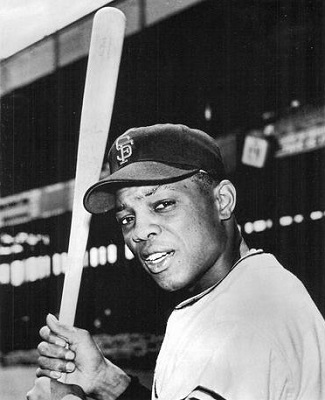
Willie Mays

May 6 …
Willie Mays is one of the greatest baseball players in American history, celebrated for transcendent athleticism, all-around excellence, and a lasting cultural impact on sports and society.
Born on May 6, 1931 in Westfield (now Fairfield), AL, Mays was raised in a large family that relocated to Birmingham during his childhood. He attended Industrial High School in Birmingham.
Mays played semiprofessional baseball in the Negro American League with the Birmingham Black Barons before signing with the New York Giants organization. His formative years and informal education in baseball came through neighborhood games, barnstorming, and valuable mentorship from seasoned players in the Negro leagues.
Mays’s on-field achievements are remarkable — a 24-time All-Star, two-time National League Most Valuable Player (1954 and 1965), recipient of 12 Gold Glove Awards, National League Rookie of the Year (1951), over 3,000 career hits, and 660 home runs. His regular-season OPS and WAR place him among the all-time greats.
Mays is celebrated for iconic moments, most famously “The Catch” in the 1954 World Series, and for seamlessly combining power, speed, defense, and base running in a manner few have matched.
Mays served in the U.S. Army during the Korean War, missing part of the 1952–1953 seasons. He returned to baseball after his military service to continue his Hall of Fame career with the San Francisco Giants following their move to the West Coast.
Throughout his career, Mays was influenced and mentored by veterans from the Negro leagues, such as Satchel Paige, from whom he learned greatly, as well as teammates in the Giants organization like Monte Irvin and Alvin Dark. His contemporaries included legends such as Mickey Mantle, Hank Aaron, Roberto Clemente, and Ernie Banks — players who defined the golden age of baseball.
Mays informally mentored younger players during and after his career, and figures like Bobby Bonds (his teammate and father of Barry Bonds) acknowledged his example and guidance. In his youth, he idolized stars of the Negro leagues and admired white major leaguers he followed on the radio and watched in person.
Mays’s honors and accolades are extensive and well-deserved. He was inducted into the National Baseball Hall of Fame in 1979 on the first ballot, won two NL MVP Awards, received 12 Gold Gloves. He also earned Rookie of the Year honors, as well as 24 All-Star selections and numerous team and league records for single-season and career achievements.
Mays was awarded the Presidential Medal of Freedom in 2015.
Beyond his statistics, the cultural significance of Willie Mays — breaking barriers as a Black superstar during the integration era, enhancing the prestige of the center field position, and serving as an ambassador for the game — ensures his enduring legacy in American sports, popular culture, and history.
