


Negro League Baseball was a constellation of professional and semi‑professional African American baseball teams and organized circuits that — from the late 19th century through mid‑20th century — built athletic excellence, commercial enterprises, and civic pride under Jim Crow and helped reshape American sports, culture, and social expectations.
Forerunners to the formal Negro leagues date to the post‑Civil War decades when Black clubs and barnstorming teams — such as the Cuban Giants (formed in the 1880s) — traveled and played exhibition games against white and other Black teams. Those early independent clubs existed within an evolving racial color line: beginning in the 1870s, amateur and professional white baseball organizations effectively excluded Black players through explicit rules and unwritten “gentleman’s agreements.”
In response, Black owners, promoters, and players developed parallel institutions: traveling teams, local clubs, and regional circuits that cultivated talent and fan bases. The growth of Black urban populations during the Great Migration (roughly 1910–1930) provided a larger paying audience, and the rise of Black‑owned newspapers — particularly The Chicago Defender and Pittsburgh Courier — helped publicize games, promote stars, and create a national conversation around Black baseball.
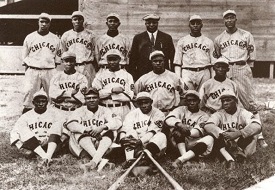
1919 Chicago American Giants
The original NNL clubs included the Chicago American Giants (Foster’s club), Kansas City Monarchs, Indianapolis ABCs, Detroit Stars, Dayton Marcos, St. Louis Giants, Chicago Giants, and the Cuban Stars.
The Eastern Colored League followed in the early 1920s, and the two leagues staged a Colored World Series in 1924. Economic shocks, internal disputes, and the institutional collapse of some teams led to the downfall of the first NNL in 1931, but resilient owners such as Gus Greenlee (owner of the Pittsburgh Crawfords) reorganized a second Negro National League in 1933 and the Negro American League formed in 1937.

The two opposing teams from the Negro National League and Eastern Colored League line up at the 1924 Colored World Series.
Over successive decades the Negro leagues’ structure shifted — leagues formed, dissolved, merged, and operated alongside strong independent clubs — yet the leagues’ marquee events, especially the East–West All‑Star Game in Chicago (first played in 1933), drew tens of thousands of fans and became cultural touchstones.
Teams and individuals made the Negro leagues into a high‑caliber athletic and business enterprise. Franchises such as the Kansas City Monarchs, Homestead Grays, Pittsburgh Crawfords, Chicago American Giants, Newark Eagles, and Birmingham Black Barons built reputations for strong rosters and consistent play. Legendary players — Josh Gibson, Satchel Paige, Cool Papa Bell, Buck Leonard, Judy Johnson, Turkey Stearnes, Martín Dihigo, and Mule Suttles — produced feats that rivaled contemporary Major League Baseball achievements, even as they were denied access to MLB’s official records for decades.
Promoters, owners, and local civic leaders were key stakeholders: Black entrepreneurs like Gus Greenlee invested heavily (Greenlee Field in Pittsburgh was privately financed), while Black newspapers and civic organizations promoted games, organized fan voting for All‑Star contests, and used the economic activity generated by teams to support broader community institutions. Audiences were primarily Black urban and rural communities who found in Negro league games not only entertainment but affirmation, social gathering, and economic opportunity: game days could boost nearby businesses, and teams often provided seasonal employment and community visibility.
Historically, the Negro leagues served multiple roles beyond sports. Athletically, they preserved and developed a style of play characterized by speed, athleticism, showmanship, and strategic innovation — players were frequently described as faster, more improvisational, and more willing to take dramatic risks on the basepaths and in the field.
Culturally, the teams and their stars became symbols of Black excellence and resistance: they provided aspirational role models at a time when segregation limited other high‑visibility arenas for African Americans.
Economically, Negro league games created circulation of money within Black neighborhoods and supported Black businesses, from concessions and vendors to nightlife venues associated with ballpark districts.
Politically and socially, the leagues helped undermine segregation’s moral and rhetorical foundations by demonstrating, to Black and increasingly white fans, that Black athletes could perform at the highest levels. Exhibition games and barnstorming tours regularly matched Negro league all‑stars against white major leaguers and often produced competitive results, challenging the myths justifying exclusion.
The long arc of Negro league history culminated in both triumph and transformation with baseball’s integration. The major institutional turning point came in 1947 when Jackie Robinson, signed by Branch Rickey and the Brooklyn Dodgers after a tryout and brief assignment to the Montreal Royals, broke MLB’s color barrier. Robinson’s success, followed by Larry Doby in the American League (1947) and the eventual signing of other Negro league stars such as Satchel Paige, Hank Aaron, Roy Campanella, and Willie Mays, signaled the beginning of the end for segregated Black professional leagues.
Integration offered Black players access to the majors’ higher salaries, broader media exposure, and institutional prestige — but it also siphoned the Negro leagues’ best talent, undermining their competitive and economic viability. By the late 1950s and into the 1960s, most Negro league clubs had folded or been reduced to semi‑professional status. The outcome was thus mixed: while integration was a monumental advance for civil rights and individual Black athletes’ careers, it also meant the dissolution of a Black‑owned and -operated sporting ecosystem that had been a source of communal autonomy and pride.
Recognition and historical reassessment have continued into the 21st century. Negro league players and organizers were inducted into the National Baseball Hall of Fame across multiple decades, and museums, archives, and scholarly projects have worked to preserve records, oral histories, and artifacts.
In December 2020 Major League Baseball announced it would recognize statistics from seven Negro major leagues (generally 1920–1948) as “major league” statistics. MLB formally incorporated Negro leagues data into its historical record beginning with database changes implemented through 2024. That formal acknowledgment corrected some historical omissions and allowed many players’ achievements to be evaluated alongside their white contemporaries.
The preservation of ballparks, commemorative events, and educational programming — led by institutions such as the Negro Leagues Baseball Museum in Kansas City and numerous regional historical societies — has helped situate the leagues within larger narratives of American social, economic, and cultural history.
The legacy of the Negro leagues extends beyond statistics. They shaped the popular aesthetics of American sports by popularizing lively, fan‑centered game experiences and by producing a generation of performers who influenced baseball technique, style, and strategy. The success and visibility of Black baseball during segregation provided tangible evidence in arguments for integration across American life: if Black athletes could draw crowds, manage franchises, and outperform expectations on the field, the rationale for separate and unequal treatment elsewhere in society was weakened. Moreover, the figure of the Negro league ballplayer — an accomplished, dignified, and often entrepreneurial public figure — helped expand representations of Black masculinity and leadership during a period when mainstream portrayals were narrow and demeaning.
Contemporary implications are also significant. The rediscovery and integration of Negro leagues’ records into mainstream statistics has altered historical rankings and brought renewed attention to players whose careers had been marginalized. Cultural projects — films, books, exhibitions, and academic studies — continue to explore how the Negro leagues intersected with labor practices, migration, urban development, and African American cultural production (music, fashion, and community organizing associated with game day rituals). The story of the Negro leagues is thus both a sports history and a window into 20th‑century America: it encompasses entrepreneurship under constraint, cultural creativity under segregation, and the complicated costs and benefits of integration.
In short, Negro League Baseball was foundational to American sports and culture: it produced world‑class athletes and managers, sustained Black economic and social networks, contested racial exclusion through excellence and entrepreneurship, and influenced the eventual desegregation of professional sports. Its history is a testament to resilience and ingenuity, and the continuing recovery and recognition of Negro leagues achievements help ensure that those contributions are fully integrated into the nation’s athletic and civic memory.