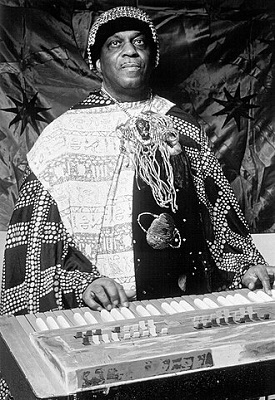
Sun Ra

May 22 …
Composer, bandleader, poet, and philosopher, Sun Ra was one of the most groundbreaking and mysterious figures in 20th century music.
Born Herman Poole Blount on May 22, 1914 in Birmingham, AL, Ra defied easy categorization. He claimed to be an angelic being from Saturn, sent to Earth to spread cosmic truth through music. While many dismissed his persona as eccentric, it was a carefully constructed mythology rooted in deep critiques of racism, history, and human limitation. His commitment to visionary thought set him apart in both sound and message.
Musically, Ra revolutionized jazz by pushing its boundaries into the realm of the unknown. He led the Arkestra, an ever-changing ensemble that moved freely between swing, bebop, avant-garde jazz, and experimental electronic music.
Ra was one of the first musicians to use synthesizers and electronic instruments in jazz. He incorporated them in ways that expanded the genre’s sonic palette.
Ra’s compositions often rejected traditional structures, embracing chaos, atonality, and free improvisation to reflect a universe in constant motion. Through this, he pioneered what would later be recognized as space jazz and laid groundwork for future experimental genres.
Beyond sound, Ra’s contribution to American culture was philosophical and political. He used music not just as art but as a medium for radical reimagining. He viewed the stage as a platform for transformation, offering audiences an escape from Earth-bound limitations and encouraging them to envision higher forms of existence.
His mythology, which blended ancient Egyptian symbolism with futuristic themes, was a powerful form of Afrofuturism — a concept that would later be explored by artists like Octavia Butler and George Clinton. By asserting an origin beyond Earth, Ra symbolically freed himself and his followers from the constraints of American racial history.
Ra’s performances were theatrical spectacles, combining elaborate costumes, cosmic imagery, and choreographed movement. These shows were more than entertainment. They were living rituals designed to awaken consciousness. His use of multimedia elements — costume, dance, lighting, and spoken word — anticipated performance art movements and music video aesthetics decades ahead of their time. In this way, he not only influenced the direction of jazz but also helped shape the broader contours of American performance art and experimental culture.
Ra also pioneered independent music production. Long before the digital age enabled artists to self-release, he founded his own label, Saturn Records, to distribute his recordings. This DIY ethic allowed him complete creative control and helped define the model for later underground and independent music movements. In resisting industry norms and racial expectations, Sun Ra modeled artistic self-sufficiency and freedom—principles that continue to resonate in hip-hop, punk, and experimental scenes.
Even after his death in 1993, Ra’s influence remains profound. The Arkestra continues to perform under the leadership of Marshall Allen, preserving and evolving his legacy. More than a musician, Ra was a cultural prophet who challenged America to reimagine itself — not just socially and politically, but spiritually and cosmically.
The work of Sun Ra remains a testament to the power of imagination to challenge oppression, transcend boundaries, and envision new futures. In the galaxy of American cultural icons, he shines as a singular, luminous force.