

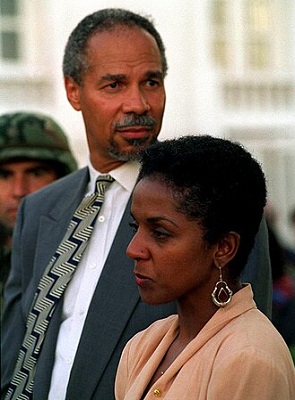
Randall Robinson


July 6 …
Randall Robinson was a formidable civil rights attorney, author, and international human rights advocate whose activism reshaped debates about U.S. foreign policy, racial justice, and global accountability.
Born on July 6, 1941 in Richmond, VA, Robinson — the younger brother of broadcast journalist and anchor Max Robinson — grew up in the segregated South, where the contradictions of American democracy were evident in daily life. He earned his undergraduate degree from Virginia Union University before graduating from Harvard Law School, experiences that honed his legal skills and heightened his moral urgency.
Inspired by the intellectual legacy of Black freedom movements and global anti-colonial struggles, Robinson committed himself to connecting the fight for civil rights at home with the broader pursuit of human rights internationally.
In 1977, he founded TransAfrica, an advocacy organization aimed at influencing U.S. policy toward Africa and the Caribbean. Under his guidance, TransAfrica became a pivotal force in the American anti-apartheid movement, organizing protests, lobbying Congress, and shaping public opinion against South Africa’s apartheid regime.
Robinson engaged in high-profile demonstrations and acts of civil disobedience, creating the momentum that led to U.S. sanctions against the apartheid government. He collaborated with contemporaries like Jesse Jackson and Walter Fauntroy, as well as members of the Congressional Black Caucus, forging alliances that linked grassroots activism with legislative efforts.
Robinson’s impact extended beyond protests, influencing intellectual and policy discussions. Through his writings and public lectures, he critiqued systemic racism in the American criminal justice system, economic disparities, and the legacy of slavery. He passionately advocated for reparations for African Americans, situating the issue within both moral and international legal frameworks.
His scholarship and activism were partly shaped by the legacy of civil rights leaders like Martin Luther King Jr., whose dedication to nonviolent resistance and global justice resonated deeply with him. Robinson’s unique approach combined legal strategy, historical insight, and moral persuasion, establishing him as a significant voice in American public discourse.
In times of political turmoil, Robinson was unafraid to take bold personal stands. In 1994, he embarked on a hunger strike to protest U.S. immigration policies affecting Haitian refugees, advocating for equitable treatment and humanitarian consideration. His activism reflected a steadfast belief that American foreign policy should uphold democratic principles and human rights standards.
Later in his life, Robinson moved to the Caribbean, where he continued to write and speak on global justice, emphasizing the interconnectedness of Black diasporic struggles. His work resonated with scholars, activists, and policymakers who sought to expand the scope of civil rights beyond domestic issues.
Throughout his life, Robinson received numerous accolades from academic institutions and advocacy organizations honoring his leadership and intellectual contributions. His writings sparked discussions in universities and policy circles, and he was frequently invited to address audiences on topics of race, democracy, and international law.
Tributes to Randall Robinson have celebrated him as a courageous and steadfast advocate whose legacy has left an indelible mark on American civil rights history. By asserting that justice at home and abroad are intertwined, he redefined the moral landscape of American activism and established himself as a significant architect of late 20th-century human rights advocacy.
