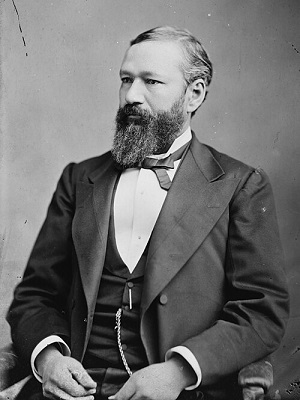
P.B.S. Pinchback


May 10 …
P.B.S. Pinchback was a pioneering figure in American history, whose life story reflects the transformative possibilities of Reconstruction-era politics and the resilience of African Americans in the post-Civil War United States.
As a publisher, politician, and military leader, Pinchback made remarkable contributions to society, particularly in advocating for the rights of Black Americans and promoting education and self-determination. His involvement in both politics and publishing marked him as one of the most influential Black public figures of his era, illustrating the potential for African Americans to transform American politics and culture.
Born Pinckney Benton Pinchback Stewart on May 10, 1837 in Macon, GA to a free Black mother and a white father, Pinchback’s early life was shaped by the intricate realities of race in the antebellum South. His family relocated to New Orleans, where he pursued an education in local public schools, striving to overcome the obstacles faced by African Americans in the segregated South.
His experiences during the Civil War, serving in the Union Army, further solidified his commitment to fighting for racial equality.
Following the war, Pinchback became actively involved in Louisiana’s Reconstruction politics, eventually rising to prominence as a state legislator and making history as the first Black governor of Louisiana — albeit briefly in 1872 after the removal of the governor-elect — and second lieutenant governor (after Oscar Dunn) in the United States. He was one of the most prominent African-American officeholders after the Civil War.
Throughout his career, Pinchback harnessed his influence in both the political and publishing realms to advocate for civil rights and the inclusion of African Americans in society. He played a key role in establishing the “Louisiana Sentinel,” an influential African American newspaper that championed Black rights, education, and self-empowerment.
Through his publishing efforts, Pinchback amplified the voices of Black Americans facing increasing racial discrimination and the erosion of Reconstruction-era advancements. His support for Black-owned businesses, educational institutions, and civil rights organizations positioned him as a pivotal figure in the quest for a more equitable and just American society.
Inspired by the intellectuals and activists of his era, particularly those advocating for equality and the upliftment of Black Americans, Pinchback admired leaders like Frederick Douglass, whose advocacy for Black rights significantly influenced his approach to public service. As a contemporary of other notable African American politicians during Reconstruction, such as Blanche K. Bruce and Hiram Revels, Pinchback’s work was deeply intertwined with broader political and social movements of the time.
He and his wife Nina were the maternal grandparents of poet and novelist Jean Toomer, who prominent as a writer during the Harlem Renaissance. Pinchback also took on the role of mentor to other young African American leaders, instilling the importance of education, political engagement, and community empowerment.
While his governorship was brief and faced political challenges, his legacy in both Louisiana and national politics serves as an enduring example of Black leadership in American governance.
The contributions of P.B.S. Pinchback have been recognized posthumously, highlighting the significant role he played in shaping the political landscape of the Reconstruction era.