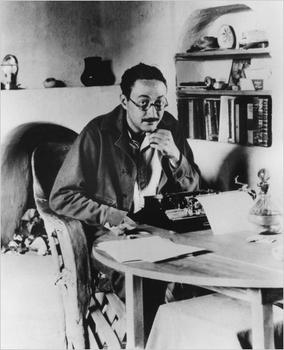
Jean Toomer

December 26 …
Jean Toomer was a groundbreaking American poet, novelist, and philosopher whose work challenged conventional notions of race, identity, and literary form in early 20th-century America.
Born Nathan Pinchback Toomer on December 26, 1894 in Washington, DC, Toomer came from a mixed-race background and was raised in both Black and white communities. His complex heritage profoundly influenced his worldview and creative expression, leading him to resist racial categorization throughout his life.
Toomer’s widowered father eventually married socialite and philanthropist Amanda America Dickson, a former enslaved woman of mixed race whose inheritance from her white father made her one of the wealthiest Black women — perhaps the wealthiest — in the nation. His maternal grandfather was the Reconstruction era politician, P.B.S. Pinchback.
Toomer’s brief, but impactful literary career positioned him as a central, though often enigmatic, figure of the Harlem Renaissance.
Toomer’s most celebrated work, Cane, published in 1923, is widely regarded as one of the most innovative and influential books of the Harlem Renaissance. A hybrid of poetry, short fiction, and drama, the book explores Black life in the rural South and urban North with lyrical intensity and modernist experimentation.
Its structure defied literary norms, and its rich imagery evoked themes of spiritual yearning, social fragmentation, and the search for identity. Cane was praised for its originality by literary figures such as Langston Hughes and Waldo Frank, and it signaled the arrival of a new, distinctly modern African American voice in literature.
Despite the acclaim surrounding Cane, Toomer distanced himself from the racial and political labels often attached to the Harlem Renaissance. He rejected being defined solely as a “Negro writer,” seeking instead to represent a universal human experience that transcended racial boundaries.
This philosophical stance, while deeply personal, led to tension with both Black and white audiences who expected him to conform to the racial dynamics of the era. His refusal to be categorized made his later work less visible during his lifetime, but it has since drawn renewed attention for its bold engagement with the complexities of identity.
After Cane, Toomer continued to write, but his focus shifted toward spirituality and philosophy, particularly after becoming involved with the teachings of the mystic George Gurdjieff. This phase of his life marked a turn inward, as he explored themes of personal transformation, self-knowledge, and spiritual evolution. While he published fewer literary works during this period, his essays, letters, and unpublished writings reveal a deep and restless intellect grappling with the deeper meanings of human existence beyond race and social constructs.
Jean Toomer’s legacy is one of artistic innovation and uncompromising vision. Though he produced only one major published book, Cane remains a cornerstone of American modernist literature and a foundational text in African American literary history. His exploration of identity, form, and the human condition influenced future generations of writers seeking to navigate the intersections of race, art, and philosophy.
The life and work of Jean Toomer continue to resonate as a testament to the power of literature to challenge boundaries and reimagine what it means to belong in a divided world.