

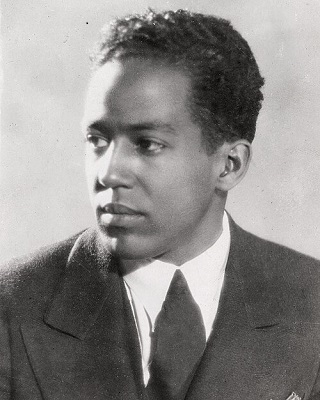
Langston Hughes


February 1 …
James Mercer Langston Hughes was a trailblazing American poet, playwright, novelist, and essayist whose work gave voice to the everyday lives, dreams, and struggles of African Americans in the 20th century.
Born on February 1, 1901, in Joplin, MO, Hughes was raised by his grandmother and later moved between several cities, experiencing the diversity and adversity of Black life across the country. These formative years informed his deep empathy and understanding of the working-class Black experience, which would become a central theme in his writing. Hughes emerged as one of the most influential figures of the Harlem Renaissance, a cultural movement that redefined Black identity and artistic expression in the 1920s and beyond.
Hughes’s literary career took off with the publication of his first collection of poetry, The Weary Blues, in 1926. His work stood out for its musicality, accessibility, and unflinching portrayal of Black life. Influenced by jazz, blues, and spirituals, Hughes developed a unique poetic voice that was rhythmic, conversational, and profoundly human. His poetry celebrated Black culture while also confronting racism, inequality, and the challenges of modern life. Poems like “Harlem (What happens to a dream deferred?)” and “Mother to Son” became iconic for their emotional resonance and social insight.
More than just a poet, Hughes was a literary polymath. He wrote short stories, novels, essays, and plays that explored the complexity of Black identity in America. His series of short stories about Jesse B. Semple, a fictional Harlem resident, used humor and wit to tackle serious social issues, while novels like Not Without Laughter reflected on the struggles and triumphs of Black families in small-town America. His works humanized Black characters in ways that had rarely been seen in American literature, offering multidimensional portrayals that challenged prevailing stereotypes.
Hughes was also a dedicated cultural advocate and an outspoken political thinker. He used his platform to highlight the importance of art in activism, insisting that Black writers and artists should reflect their communities and remain connected to the social realities around them. In essays such as “The Negro Artist and the Racial Mountain,” Hughes argued that Black artists did not need to conform to white literary traditions to achieve greatness — that their authenticity was their strength. This perspective inspired a new generation of Black writers and thinkers to embrace their voices unapologetically.
His contributions extended beyond the page and into the realm of global consciousness. Hughes traveled widely, connecting with artists and political movements in Africa, the Caribbean, the Soviet Union, and beyond. He saw the struggles of African Americans as part of a larger, global fight against colonialism and oppression. This international outlook enriched his writing and affirmed his commitment to solidarity among oppressed peoples, making him not just a literary figure but a citizen of the world.
Langston Hughes’s legacy continues to shape American literature and culture. As a pioneer of jazz poetry, a champion of Black storytelling, and a fearless advocate for cultural dignity, he opened doors for countless artists and reshaped the nation’s literary canon. His work endures not only for its artistic brilliance but for its powerful affirmation of Black life — its beauty, its pain, its joy, and its dreams.
Langston Hughes showed the world that poetry could be both a mirror and a weapon, capturing truth while inspiring change.
