

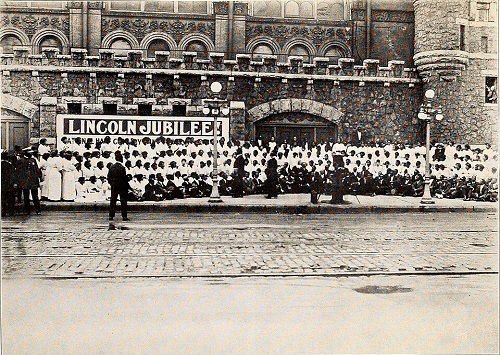
National Half Century Exposition and Lincoln Jubilee


August 22 …
The National Half Century Exposition and Lincoln Jubilee — held in Chicago August 22 to September 16, 1915 — was a landmark celebration marking 50 years of African American progress since the abolition of slavery.
Listen to this story:
Organized by the National Half Century Anniversary Exposition Association, the event was intended to commemorate the Emancipation Proclamation and showcase the achievements of Black Americans in the face of ongoing racial discrimination and systemic inequality. Held at the Coliseum, a grand exhibition hall in Chicago, the Jubilee attracted thousands of visitors and featured displays highlighting advancements in education, the arts, politics, science, industry, and business within the Black community.
At a time when African Americans faced widespread disenfranchisement, violence, and segregation under Jim Crow laws, the Lincoln Jubilee served as a bold assertion of Black excellence and self-determination. It created a rare space for African Americans to control their own narrative, celebrate their own heroes, and define their contributions on their own terms.
The exposition was a response to the marginalization of Black achievements in national events like world’s fairs, which often presented African Americans in degrading or stereotypical ways. In contrast, the Jubilee placed pride, dignity, and progress at the center of its message.
The event featured speeches from prominent leaders, including Booker T. Washington and W.E.B. Du Bois, who despite differing philosophies, shared a commitment to the advancement of the race. Exhibits and panels showcased the accomplishments of Black-owned businesses, artists, educators, and inventors, providing a vivid and compelling counter-narrative to the racist portrayals so common in early 20th-century media.
Educational institutions like Tuskegee Institute and Howard University presented their work, while visual artists and writers contributed to a cultural showcase that laid the groundwork for the Harlem Renaissance just a few years later.
The Association for the Study of Negro Life and History was established by a group of prominent attendees who met during the event. These founding members included Carter G. Woodson, William B. Hartgrove, George Cleveland Hall, Alexander L. Jackson, and James E. Stamps.
Perhaps one of the most significant legacies of the Lincoln Jubilee was the establishment of a broader consciousness around African American history and identity. The event fostered a collective memory that linked the past struggles of slavery to contemporary movements for justice and equality. It emphasized historical continuity and the need to build institutions that would preserve and promote Black heritage. The Jubilee also inspired publications, including souvenir books and newsletters, that documented the event and became lasting testaments to the achievements and aspirations of the Black community.
The Jubilee’s emphasis on progress, self-help, and cultural pride foreshadowed many of the philosophies that would later emerge in the Civil Rights and Black Power movements. It created networks of Black professionals, activists, and entrepreneurs who continued to collaborate and organize in the decades that followed.
The event also demonstrated the power of representation and visibility, helping to plant the seeds for future national recognitions of African American history, including Black History Month and the eventual establishment of institutions like the Smithsonian National Museum of African American History and Culture (NMAAHC).
The National Half Century Exposition and Lincoln Jubilee remains a pivotal moment in American history, not only as a celebration of freedom’s anniversary, but as a bold declaration of Black presence and potential in a country still struggling with racial inequality. It offered a vision of unity, resilience, and pride that inspired future generations to claim space, tell their own stories, and continue the work of building a more inclusive and truthful national narrative.
Its legacy lives on as a symbol of how commemoration can also be a form of cultural and political resistance.
