Freedom Riders


May 4 …
The Freedom Riders were a brave collective of interracial civil rights activists whose unwavering resolve to confront segregation in the South played a pivotal role in shaping the struggle for equality into a landmark movement in United States history.
The inception of the Riders dates back to May 4, 1961, when 13 activists — organized by the Congress of Racial Equality (CORE) — set off from Washington, DC on interstate buses headed for New Orleans. Their mission was to challenge Supreme Court rulings like Boynton v. Virginia, which deemed segregation in interstate bus terminals unconstitutional. Despite these legal victories, many Southern states persisted in enforcing segregation through intimidation and violence.
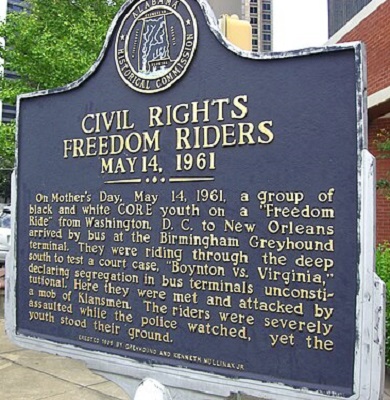
Drawing inspiration from earlier nonviolent protests and the teachings of Mahatma Gandhi, the riders aimed to highlight the disparity between federal law and local enforcement. Their efforts escalated into a national crisis when mobs attacked buses in Alabama, culminating in the firebombing of a Greyhound bus near Anniston on May 14, 1961. The violence against these peaceful demonstrators shocked Americans nationwide and gained international attention during the height of the Cold War, undermining the United States’ efforts to promote democracy abroad while it tolerated racial injustice at home.
Key figures in the Freedom Rides included activists such as John Lewis, Diane Nash, James Farmer, Bernard Lafayette, Charles Person, Hank Thomas, Genevieve Hughes, and Joan Trumpauer Mulholland.
James Farmer, co-founder of CORE, played a pivotal role in organizing the rides, while Diane Nash, a student leader from the Nashville Student Movement, emerged as a crucial strategist after the initial riders faced brutal attacks. John Lewis, who would later serve as a U.S. Congressman, endured numerous beatings and arrests while steadfastly adhering to nonviolent resistance. The movement also heavily drew on student activists associated with the Student Nonviolent Coordinating Committee (SNCC), many of whom faced imprisonment or even death.
Ultimately, hundreds of additional volunteers joined the campaign, traveling to Mississippi and other Southern states despite threats from white supremacist groups and opposition from local authorities. Their extraordinary bravery showcased remarkable moral resolve and inspired a new generation of civil rights activism.
The Riders had a significant impact on American civil rights, social justice, culture, and history. Their actions compelled the federal government, particularly Attorney General Robert F. Kennedy and the Interstate Commerce Commission, to take stronger measures against segregation in interstate travel facilities.
By September 1961, new federal regulations banned segregated seating areas, restrooms, and restaurants in interstate bus terminals across the South. Beyond these legal victories, the riders transformed public awareness of racial injustice by revealing the violent backlash African Americans faced when pursuing basic constitutional rights.
Television broadcasts and newspaper coverage brought graphic images of beatings, arrests, and mob violence into American homes, bolstering support for the broader Civil Rights Movement. The Freedom Rides also fostered collaboration among organizations such as CORE, SNCC, and the Southern Christian Leadership Conference (SCLC) led by Dr. Martin Luther King Jr. Their disciplined approach to nonviolent protest left a lasting influence on subsequent campaigns, including the Birmingham Movement, the March On Washington, and the Selma Voting Rights Marches.
The Riders’ sacrifices resulted in gains for African Americans and other marginalized groups who attained greater access to equal treatment under federal law, further accelerating the fight for civil rights. Their efforts were instrumental in the passage of landmark legislation such as the Civil Rights Act of 1964 and the Voting Rights Act of 1965.
In later decades, the Riders received numerous honors and accolades for their courage and historical significance. In 2011, many surviving Riders were awarded the Congressional Gold Medal, one of the highest civilian honors in the United States, in recognition of their contributions to justice and equality. Participants like John Lewis emerged as internationally respected figures, celebrated for their lifelong commitment to human rights and democracy.
Today, the Freedom Riders are enduring symbols of bravery, interracial cooperation, and peaceful resistance, and their legacy continues to influence modern movements advocating equality, justice, and social reform throughout the United States and beyond.
About The Photo: