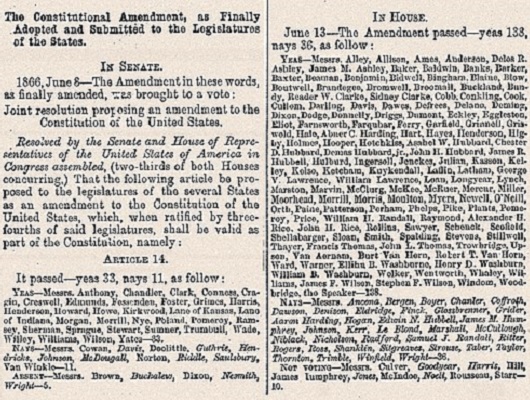
Fourteenth Amendment




July 9 …
The Fourteenth Amendment to the U.S. Constitution (Amendment XIV) — ratified on July 9, 1868 — is a cornerstone of American civil rights.
The amendment has played a crucial role in shaping the legal and cultural landscape of the nation, particularly in protecting individual freedoms, ensuring equality under the law, and granting citizenship rights to all individuals born or naturalized in the United States. It stands as one of the most frequently litigated amendments in American jurisprudence, leaving a lasting impact on the evolution of civil rights and social justice.
Adopted in the aftermath of the Civil War, the amendment is part of the Reconstruction Amendments — along with the Thirteenth Amendment and Fifteenth Amendment — aimed at addressing the legal and social challenges that arose from the end of slavery and the integration of formerly enslaved African Americans into society.
This amendment’s key provisions include the Equal Protection Clause, the Due Process Clause, and the Citizenship Clause, all designed to secure the rights of freedmen and ensure equal protection under the law for all citizens, regardless of race or prior status as slaves. It marked a significant departure from the historical policies and laws that had enforced racial discrimination and segregation.
The demographic impact of the amendment was profound, benefiting not only African Americans, but also other marginalized groups. It laid a foundation for subsequent civil rights victories for women, Native Americans, and immigrants.
In the subsequent decades, the Equal Protection Clause emerged as a vital tool for challenging discriminatory laws that disproportionately impacted people of color, women, and other minorities. Over time, its broad language concerning equality has been interpreted to address critical issues such as desegregation, voting rights, and marriage equality.
Key figures in the drafting of the amendment included Republicans like Senator Jacob Howard of Michigan and Representative John Bingham of Ohio, who were instrumental in shaping its language. These legislators, among others, were dedicated to embedding civil rights protections within the Constitution following the Civil War, reflecting a belief in the inherent dignity and equality of all citizens.
The political climate of the era, marked by efforts to reintegrate former Confederate states into the Union, contributed to the contentious debate surrounding the Amendment, with Southern states strongly opposing its provisions.
The social and cultural implications of the amendment have been extensive. It not only redefined citizenship in the U.S., but also transformed the relationship between individuals and the state. Landmark Supreme Court cases — such as Brown v. Board of Education (1954) and Roe v. Wade (1973) — have referenced the amendment, highlighting its evolving role in American legal and cultural discussions.
Over the years, this amendment has become emblematic of the fight for justice, equality, and human rights. It has influenced social movements and the enduring quest for a more inclusive society.
The provisions of the Fourteenth Amendment have profoundly shaped American history, steering the nation toward a more just and equitable future, even as interpretations and applications of its clauses continue to develop.