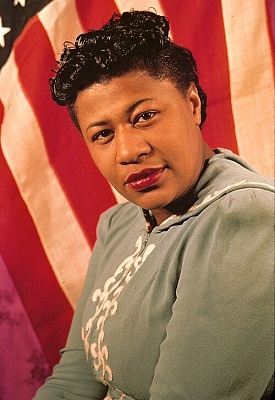
Ella Fitzgerald
April 25 …
Ella Fitzgerald — often referred to as the “First Lady of Song” — was one of the most influential and celebrated vocalists in American music history.
Born on April 25, 1917 in Newport News, VA and raised in Yonkers, NY, Fitzgerald experienced a tumultuous childhood marked by poverty and personal hardship. Despite these early struggles, her natural musical talent began to shine through in her teenage years. At the age of 17, she won an amateur contest at the Apollo Theater in Harlem, a performance that launched her into the world of professional music and changed the trajectory of her life.
Fitzgerald’s early career took off in the 1930s when she became the featured singer with the Chick Webb Orchestra. Her 1938 hit, “A-Tisket, A-Tasket,” made her a household name and showcased her unique combination of vocal clarity, rhythmic precision, and playful charm.
After Webb’s death, she took over the band — an uncommon leadership role for a woman in jazz at the time — and continued to develop her style. As she transitioned into a solo career in the 1940s, Fitzgerald began to refine her vocal technique and gain recognition for her masterful use of scat singing, a form of vocal improvisation that she helped to elevate into an art form.
Throughout the 1950s and 1960s, Fitzgerald recorded a series of acclaimed songbook albums featuring the works of America’s greatest composers, including George and Ira Gershwin, Cole Porter, Duke Ellington, and Irving Berlin. These albums not only highlighted her vocal versatility and impeccable diction but also helped to canonize the Great American Songbook as a central pillar of American culture.
With each recording, Fitzgerald brought new emotional depth and technical brilliance to songs that might otherwise have faded into nostalgia. Her interpretations became definitive versions, setting a standard that few could match.
Fitzgerald’s contributions extended beyond her remarkable voice. As a Black woman in a racially segregated industry, she broke barriers in venues and on airwaves where few artists of color were welcome. She faced discrimination head-on and often used her growing fame to challenge exclusionary policies.
One notable example was when legendary manager and producer Norman Granz insisted on integrated audiences at Fitzgerald’s concerts, even canceling performances if venues refused. Her success helped to pave the way for other artists of color in jazz, pop, and beyond, proving that excellence could shatter even the most persistent forms of bias.
In addition to her achievements in music, Fitzgerald was known for her humility, generosity, and resilience. She avoided the spotlight offstage, preferring to let her artistry speak for itself. Despite personal health challenges later in life, she continued to perform into the 1990s, always maintaining the elegance and warmth that endeared her to millions.
She won 13 Grammy Awards, received the National Medal of Arts, and was honored with the Presidential Medal of Freedom. Her career was a model of longevity and integrity, fueled by an unwavering devotion to her craft.
Ella Fitzgerald’s legacy is one of enduring beauty and transformative power. She reshaped American music through her recordings, performances, and sheer vocal brilliance. More than a singer, she was a cultural icon who brought people together across racial, social, and generational lines. Her music continues to inspire artists and listeners around the world, serving as a timeless reminder of what the human voice can achieve.
Through her unparalleled talent and quiet determination, Ella Fitzgerald became one of the greatest interpreters of song in history and an essential voice in the story of American culture.