Dizzy Gillespie
October 21 …
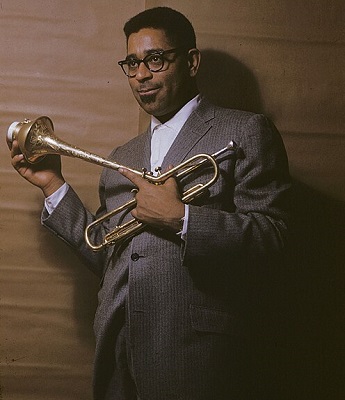
Dizzy Gillespie was a revolutionary American trumpeter, composer, and bandleader whose brilliance, humor, and innovation helped reshape jazz into a modern art form and left an indelible mark on American music, entertainment, culture, and history.
Born on October 21, 1917 in Cheraw, SC, John Birks Gillespie emerged from a musically vibrant yet challenging upbringing to become one of the most significant figures of the 20th century. His brilliant technique, distinctive bent trumpet bell, playful stage presence, and bold creativity made him an iconic figure, but it was his musical intellect that permanently transformed jazz’s trajectory.
Gillespie’s legacy is inextricably linked to the emergence and evolution of bebop, a fast-paced and harmonically intricate style that shifted jazz from popular dance music to a refined form of artistic expression. Alongside Charlie Parker, he was a pioneer of bebop in the 1940s, introducing advanced chord structures, rhythmic complexities, and virtuosic improvisation that both challenged musicians and captivated audiences.
Not only was Gillespie a master trumpeter, but he was also a prolific composer, creating timeless pieces such as “A Night in Tunisia,” “Groovin’ High,” and “Salt Peanuts,” which have become foundational works in the jazz repertoire. His big bands and small ensembles nurtured generations of musicians, helping to codify bebop and disseminate it across the globe.
Musically, Gillespie was influenced by early idols like Roy Eldridge, whose fiery trumpet style ignited his technical aspirations, as well as the swing era legends he encountered while performing with bands led by Cab Calloway, Earl Hines, and Billy Eckstine. Hines and Eckstine, in particular, played vital roles as mentors, allowing Gillespie the freedom to experiment and refine his compositional voice.
His contemporaries — Charlie Parker, Thelonious Monk, Bud Powell, and Max Roach — were also redefining jazz during this period. Rather than seeing them as rivals, Gillespie thrived in collaboration, collectively pushing boundaries while fostering individuality among his peers.
One of Gillespie’s most significant cultural contributions was his blending of jazz with Afro-Cuban and Latin American musical traditions. Collaborating with artists like Chano Pozo, he wove complex polyrhythms, congas, and Afro-Cuban forms into jazz, creating a new musical language that broadened the genre’s global appeal.
As a cultural ambassador for the U.S. State Department during the Cold War, Gillespie traveled extensively across Africa, the Middle East, Latin America, and Europe, utilizing music as a form of diplomacy. This helped to position jazz as a symbol of American creativity, freedom, and cross-cultural dialogue.
Throughout his lifetime, Gillespie garnered numerous awards and honors that reflected his monumental impact. He won multiple Grammy Awards, including a Grammy Lifetime Achievement Award, received the Kennedy Center Honors, and was designated a National Endowment for the Arts Jazz Master. He was also awarded the Presidential Medal of Freedom, one of the United States’ highest civilian honors.
Beyond formal accolades, Gillespie’s legacy endures in the language of modern jazz, in the myriad musicians he inspired, and in the enduring notion that joy, intellect, and innovation can coexist.
The life and work of Dizzy Gillespie not only helped define a genre but also established a distinctly American cultural voice that continues to resonate worldwide.