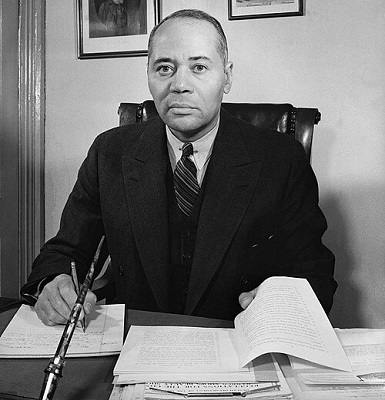
Charles Hamilton Houston

September 3 …
Charles Hamilton Houston was a towering figure in American legal history, whose relentless efforts to dismantle racial segregation laid the groundwork for some of the most transformative civil rights advances of the 20th century.
Listen to this story:
Born on September 3, 1895 in Washington, D.C., Houston was shaped by a rich intellectual tradition and a sense of civic responsibility instilled by his parents and community. He graduated from Amherst College — while there he was elected to the Phi Beta Kappa honor society — and later from Harvard Law School, where he distinguished himself as the first Black editor of the Harvard Law Review, and graduated cum laude with a bachelor’s of law in 1922 and a DJS from Harvard in 1923. His legal mind was sharpened by both rigorous academic training and his experiences serving in a segregated military during World War I, which cemented his determination to use the law as a tool for social change.
Houston’s most enduring legacy lies in his strategic dismantling of the legal foundations of racial segregation, particularly in the realm of education. As vice-dean of Howard University School of Law, he transformed the institution into a crucible for civil rights advocacy, training a generation of Black lawyers — including Thurgood Marshall — who would go on to challenge racial injustice at every level of American society.
Houston emphasized a legal philosophy that viewed the Constitution not as a static document, but as a living instrument capable of securing true equality. Under his leadership, Howard Law became a center for legal scholarship and action aimed at confronting institutional racism.
Houston’s work with the NAACP Legal Committee in the 1930s was revolutionary. He meticulously developed a strategy to attack segregation by exposing the inherent inequalities of the “separate but equal” doctrine established in Plessy v. Ferguson. His legal brilliance was evident in his approach: rather than mount a direct assault on segregation broadly, he chose to focus on areas where disparities were stark and irrefutable, such as in public school funding and facilities.
In cases like Missouri ex rel. Gaines v. Canada, Houston laid the legal foundation that would culminate in the landmark decision in Brown v. Board of Education, argued by his protégé Marshall after his death.
Beyond his court victories, Houston’s contribution to American society lies in his redefinition of the role of the lawyer. He famously declared that a lawyer is “either a social engineer or a parasite on society,” encapsulating his belief that the law must serve justice and equality. This ethos not only shaped the careers of his students, but also resonated throughout the Civil Rights Movement, influencing the way legal activism was deployed as a method of nonviolent resistance and systemic reform.
Houston’s influence extended well beyond legal circles. His strategic mind, moral clarity, and unwavering commitment to justice helped to shift the national conscience regarding civil rights. At a time when open racism was often codified into law, he demonstrated that intelligent, principled legal advocacy could serve as a powerful force against entrenched inequality. He operated with a deep understanding of American institutions and used their mechanisms to hold them accountable to their highest ideals.
Though Houston died in 1950, before seeing the full fruits of his labor, his contributions endure as a cornerstone of American jurisprudence and social progress. His work fundamentally altered the trajectory of the United States by embedding the pursuit of racial justice within the legal system. In doing so, he not only helped to overturn discriminatory laws, but also reimagined the possibilities of constitutional democracy.
The legacy of Charles Hamilton Houston is one of courage, intellect, and a profound belief in the power of law to deliver on the promise of liberty and justice for all.