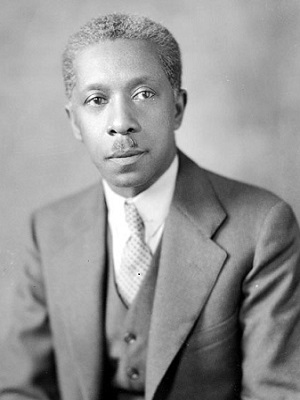
Addison N. Scurlock

June 19 …
Addison Norton Scurlock was a pioneering African American photographer whose work captured the dignity, beauty, and complexity of Black life during the early to mid-20th century.
Born on June 19, 1883 in Fayetteville, NC, Scurlock moved to Washington, DC with his family as a young man and became deeply embedded in a city that was rapidly becoming a hub for Black intellectual and cultural life. He trained in photography under the tutelage of white photographers but quickly established his own unique style and perspective.
In 1911, he opened the Scurlock Studio on U Street, which would become one of the most important cultural landmarks in the nation’s capital. For many African Americans in Washington, a photograph by Scurlock was more than a picture — it was a symbol of self-worth and achievement.
Scurlock’s photography stood in stark contrast to the demeaning and stereotypical images of Black people that dominated popular media at the time. His portraits emphasized elegance, pride, and professionalism. Whether photographing families, civic leaders, or ordinary citizens, he consistently portrayed his subjects with a reverence that elevated their image and presence.
Through his lens, Scurlock documented a Black Washington that was striving, thriving, and determined to be seen in its full humanity. His work became a counter-narrative to the racist visual culture that sought to marginalize African Americans.
Over the years, Scurlock photographed an extraordinary array of figures, from civil rights leaders and politicians to artists and athletes. Notably, he took portraits of icons such as Booker T. Washington, Marian Anderson, Carter G. Woodson, and Duke Ellington. His studio became a cultural anchor for the city’s Black middle and upper classes, offering them a space to see themselves reflected with pride and sophistication.
Beyond individual portraits, Scurlock also chronicled the broader African American experience in Washington, DC, capturing pivotal moments in community life, from church events and graduations to political rallies and protests. He played a critical role in visually documenting the impact of the Great Migration, World Wars, and the early stirrings of the Civil Rights Movement. His photographs serve not only as art, but also as an essential historical archive, preserving aspects of Black life that were too often overlooked or erased by mainstream institutions.
Scurlock’s work was deeply rooted in the ethos of racial uplift. He understood the power of imagery in shaping public perception and identity, and he used his camera as a tool for advocacy and empowerment. In an era when Black people were routinely excluded from fair representation, his photographs offered an alternative vision — one that affirmed their humanity and aspirations. His artistry combined technical excellence with a deep cultural sensitivity, making his images both aesthetically compelling and socially meaningful.
The Scurlock Studio, which remained active under the direction of his sons George and Robert after his death in 1964, continued his legacy for decades. The studio adapted to changing times while maintaining the values that Addison instilled — excellence, respect, and community service. The vast archive of images created by the Scurlock family is now housed at the Smithsonian Institution, where it remains a vital resource for scholars, artists, and the general public interested in African American history and culture.
Scurlock’s contribution to American photography goes far beyond technical skill. He redefined how Black Americans could be seen and how they saw themselves. His legacy is a testament to the transformative power of visual storytelling, and his life’s work stands as both a historical record and an enduring source of cultural pride.
Through his camera, Addison N. Scurlock honored the resilience, grace, and dreams of a people, making him not just a photographer, but a visual historian of Black America.