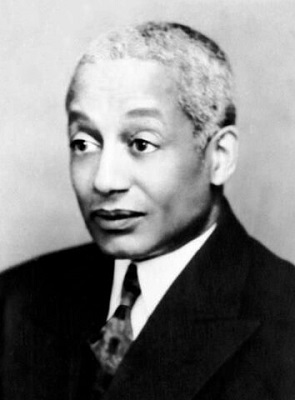
Alain Locke

September 13
Alain LeRoy Locke, was a distinguished philosopher, writer, and educator who played a transformative role in American intellectual and cultural life.
Born on September 13, 1885 in Philadelphia, PA, and a prodigy from a young age, Locke graduated from Harvard University and became the first African American Rhodes Scholar, studying at the University of Oxford before earning a Ph.D. in philosophy from the University of Berlin and then Harvard. His academic excellence and global exposure deeply informed his worldview and fueled his commitment to elevating African American culture within the broader fabric of American society.
Locke is best remembered as the intellectual architect of the Harlem Renaissance, a cultural and artistic explosion in the 1920s that celebrated Black identity and creativity. His seminal anthology, “The New Negro,” published in 1925, gathered essays, poems, and stories from leading African American thinkers and artists of the time. In this work, Locke articulated a vision of African Americans as creators of a vibrant, independent culture with deep roots in both African heritage and the American experience. He encouraged Black artists to embrace their racial identity with pride and to use art as a tool for self-definition and social change.
As a professor at Howard University, Locke revolutionized the teaching of philosophy by introducing students to a global and pluralistic perspective. He believed that education should empower individuals to think critically about themselves and the world, and he consistently challenged Eurocentric traditions by integrating non-Western thought into his curriculum. Locke’s dedication to academic rigor and intellectual diversity influenced generations of students, many of whom became leaders in civil rights, literature, and academia. His emphasis on cultural pluralism laid the groundwork for the later development of multicultural education in the United States.
Locke’s influence extended beyond academia. He was deeply engaged in the social and political issues of his time, advocating for civil rights, racial equality, and cross-cultural understanding. Though not a mass movement leader in the mold of later activists, Locke believed that lasting change began with reshaping hearts and minds. Through his writings and public lectures, he called for a reimagining of American democracy — one that truly embraced the diversity of its citizens. His philosophical work promoted the idea that cultural differences should be seen not as barriers, but as enriching elements of a shared national identity.
Despite his profound contributions, Locke often faced the limitations of racism in academia and society. As an openly gay Black man during a time of widespread discrimination, he navigated personal and professional challenges with remarkable resilience. Though his public persona was carefully measured, his life embodied a quiet defiance of social norms, and his legacy speaks to the importance of intellectual courage and authenticity in the face of exclusion. His example continues to inspire those who push against the boundaries of identity and strive to expand the possibilities of American thought.
Alain Locke’s impact on American history is immense yet still underappreciated by many. As the “Father of the Harlem Renaissance,” he helped catalyze a movement that redefined how African Americans saw themselves and how the nation viewed them in return. His vision of cultural democracy and his insistence on the value of diverse voices helped shape the direction of American education and public life.
In honoring Alain Locke, we recognize a thinker who not only chronicled change but who helped usher it into being — through scholarship, through mentorship, and through a tireless belief in the transformative power of ideas.