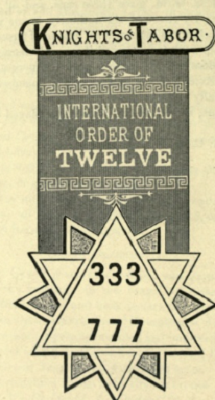
Knights and Daughters of Tabor


August 12 …
The International Order of Twelve Knights and Daughters of Tabor (IOT) was among the most significant African American fraternal and mutual aid organizations of the late 19th and early 20th centuries.
Founded on August 12, 1872 in Independence, MO by Rev. Moses Dickson, the order emerged during the difficult years after the Civil War, when Black Americans were largely excluded from white insurance systems, hospitals, and civic institutions. Dickson — a minister, abolitionist, and organizer — had earlier participated in secret antislavery activities through a clandestine organization known as the “Order of Twelve,” established in the 1840s. After emancipation, he transformed those ideals of Black self-help and collective protection into a public benevolent society dedicated to racial advancement, economic cooperation, and social welfare.
The Taborians grew rapidly across the South and Midwest during the era of segregation. Local lodges offered sickness and burial insurance, financial assistance to widows and orphans, and opportunities for civic leadership in Black communities. Women participated through the Daughters of Tabor, which became an essential branch of the organization, expanding its influence among Black families and churches. By the early 20th century, the order operated thousands of lodges and claimed a substantial membership across states including Mississippi, Arkansas, Texas, and Oklahoma.
The organization became especially influential in the town of Mound Bayou in Mississippi, the historic all-Black Delta town and major center of Taborian activity. Mound Bayou eventually served as one of the order’s principal headquarters and as the site of the famous Taborian Hospital, established in 1942.
The hospital was among the few modern medical facilities in the segregated South that served African Americans and allowed Black physicians and nurses to practice professionally. Under the leadership of Grand Mentor Perry M. Smith and surgeon T.R.M. Howard, the hospital became nationally respected for its quality of care and came to symbolize the Taborians’ broader commitment to Black institution-building and economic independence.
Several notable African Americans were affiliated with the order, including the following individuals.
- Scipio Africanus Jones, a Taborian and prominent Arkansas attorney who successfully defended Black defendants in the aftermath of the Elaine Massacre trials, embodied the organization’s emphasis on Black legal and civic leadership.
- A.C. Jackson, widely regarded as one of the era’s most skilled Black surgeons, was linked to the order’s medical initiatives before his murder during the 1921 Tulsa Race Massacre.
- John Angelo Lester represented the professional class of physicians and educators associated with the organization’s work in medicine and community uplift.
- Minnie L. Fisher became known for her lifelong service to the Taborians and for her leadership in preserving Black civic institutions in Mound Bayou.
Although membership declined in the latter part of the 20th century as government welfare programs and desegregation reduced the role of fraternal insurance organizations, the International Order of Twelve Knights and Daughters of Tabor remain historically significant. The order demonstrated how African Americans built powerful self-help institutions during the Jim Crow era, creating networks of economic support, healthcare, leadership, and community identity at a time when racial discrimination excluded them from many public and private services.
Selected Sources:
- Dickson, Moses. Manual of the International Order of Twelve of Knights and Daughters of Tabor. St. Louis: International Order of Twelve Publishing Department, 1891.
- Green, Elisa. “Taborian Hospital and the Promise of Black Health Care in Mississippi.” Journal of Mississippi History 67, no. 2 (2005): 145–168.
- Payne, Melvin I. “Black Fraternal Orders and Mutual Aid Societies in the Mississippi Delta.” Phylon 42, no. 1 (1981): 33–47.
- Scottish Rite Masonic Museum and Library. “International Order of Twelve.” August 1, 2017. Accessed May 6, 2026.
- Stichting Argus. “International Order of Twelve / Daughters of Tabor.” Last modified 2011. Accessed May 6, 2026.