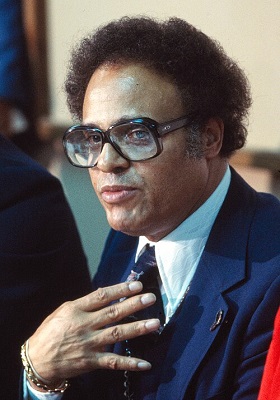
Benjamin Hooks



January 31 …
Benjamin Hooks was a prominent attorney, minister, and civil rights advocate whose leadership significantly shaped the modern Civil Rights Movement in the United States.
Born on January 31, 1925 in Memphis, Hooks grew up in the segregated South, an experience that profoundly shaped his lifelong dedication to justice and equality. He attended LeMoyne College before serving in the U.S. Army during World War II. Following his military service, he earned a law degree from DePaul University College of Law. This education, coupled with his early exposure to systemic inequality, laid the foundation for his dual career as a minister and legal advocate.
Hooks’s most significant contribution came as the executive director of the NAACP, a position he held from 1977 to 1992. During his tenure, he worked diligently to enhance the organization’s legal, political, and grassroots influence, concentrating on voting rights, employment discrimination, and educational equity.
Hooks drew inspiration from earlier civil rights pioneers like Martin Luther King Jr. and Thurgood Marshall, whose legal and moral strategies significantly shaped the movement. His contemporaries included figures such as Roy Wilkins, whom he succeeded at the NAACP, as well as Andrew Young. He also played a pivotal role as a mentor to younger civil rights attorneys and activists within the NAACP and the wider justice community, fostering a new generation of leadership committed to institutional reform and political engagement.
Hooks’s broader impact on American society and culture stems from his steady, institution-building approach to civil rights advocacy during a time of shifting national priorities. Rather than solely emphasizing protest, he focused on legal strategies, voter participation, and policy engagement as essential tools for fostering lasting change. His efforts earned him numerous accolades, including the Presidential Medal of Freedom in 2007, as well as recognition from the NAACP for his decades of service and leadership in advancing civil rights.
The leadership of Benjamin Hooks was instrumental in sustaining the Civil Rights Movement into the late 20th century, ensuring its ongoing relevance in discussions surrounding equality, justice, and democracy in American life.