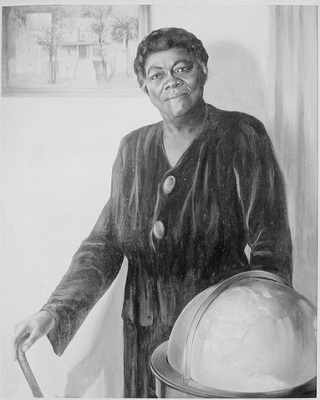
Mary McLeod Bethune

July 10 …
Mary McLeod Bethune was a visionary educator, civil rights advocate, and government advisor whose legacy is deeply woven into the fabric of American history.
Born on July 10, 1875 in Mayesville, SC, to formerly enslaved parents, Bethune rose from humble beginnings to become one of the most influential Black women of the 20th century. Her early life was shaped by a passion for education, inspired by the opportunity to attend a mission school — a rare privilege for a young Black girl in the post-Reconstruction South. From that point forward, Bethune became convinced that education was the key to racial advancement and equality.
Determined to expand access to education, Bethune founded the Daytona Literary and Industrial School for Training Negro Girls in 1904 with just five students and $1.50. Over time, the school grew in both size and reputation, eventually merging with the Cookman Institute for Men to become Bethune-Cookman College, one of the few accredited Black colleges of its time. As its president, Bethune was a trailblazer — not only shaping the academic futures of thousands of students, but also setting a powerful example of Black female leadership in higher education.

Bethune with girls from the Literary & Industrial Training School for Negro Girls in Daytona, circa 1905. (photo from the Florida State Archives Photographic Collection)
Bethune’s influence reached the highest levels of American government. She became a trusted advisor to President Franklin D. Roosevelt and served as the Director of the Division of Negro Affairs for the National Youth Administration (NYA) from 1936 to 1944. This made her the highest-ranking African American woman in the federal government at the time. In this role, she created opportunities for thousands of young Black men and women to gain skills and employment during the Great Depression, advocating tirelessly for racial equality in New Deal programs.
A master of diplomacy and coalition-building, Bethune used her political connections to advocate for desegregation, voting rights, and equal access to public services. She was one of the few African Americans invited to help found the United Nations in 1945, where she continued her push for global human rights. Her belief in the power of education, political activism, and cross-racial alliances helped set the stage for the civil rights movement of the 1950s and 1960s.
Bethune’s enduring influence can be seen in her writings and speeches, particularly her “Last Will and Testament,” in which she urged future generations to hold fast to dignity, hope, and racial pride. She emphasized faith, education, and service as the cornerstones of a better future—not just for African Americans, but for all Americans. Her words and actions have inspired countless leaders and educators to continue her work in the ongoing pursuit of justice and equality.
Bethune passed away in 1955, but her contributions to American history remain profound. She was posthumously honored with a statue in the U.S. Capitol in 2022, becoming the first Black woman to be so recognized in the National Statuary Hall.
Through her pioneering work in education, civil rights, and government, Mary McLeod Bethune left a powerful legacy of empowerment and transformation. She proved that with vision, courage, and relentless determination, one person can indeed change a nation.