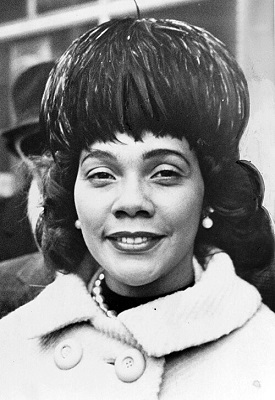
Coretta Scott King


April 27 …
Coretta Scott King was a civil rights leader, activist, author, and cultural visionary whose life’s work helped shape the moral and political direction of modern America.
Born on April 27, 1927 in Heiberger, AL, Scott King grew up in a segregated society that instilled in her both resilience and a determined spirit to confront injustice.
A talented student and musician, she sought higher education at Antioch College and the New England Conservatory of Music, aspiring to carve out a career as a classical singer. However, her marriage to Martin Luther King Jr. in 1953 placed her in the heart of a rising movement that would reshape the nation.
From the very beginning, Scott King was more than a supportive spouse. She was an intellectual equal and strategist who shared her husband’s dedication to nonviolent resistance, inspired by Mahatma Gandhi’s teachings. During the Montgomery Bus Boycott, she faced threats and intimidation, yet remained steadfast and composed in public.
Her activism transcended racial equality, encompassing peace advocacy, opposition to the Vietnam War, women’s rights, and later, LGBTQ+ equality — causes she viewed as interconnected struggles for human dignity. After her husband’s assassination, she stepped into a more visible leadership role, committed to institutionalizing his philosophy and maintaining the momentum of the movement.
In 1968, Scott King founded The King Center in Atlanta, establishing it as a living memorial dedicated to nonviolence, education, and social change. Through lectures, international travel, and policy advocacy, she tirelessly worked to secure recognition of her husband’s legacy, culminating in the designation of MLK Day as a federal holiday in 1983.
This accomplishment demanded years of coalition-building and negotiation, highlighting her political skill and determination. The King Center became a hub for training activists and promoting global human rights initiatives, reflecting her belief in the universality of the civil rights movement’s principles.
Scott King moved within a circle of notable civil rights figures — including Rosa Parks, Ralph Abernathy, and Andrew Young — all of whom contributed significantly to the broader struggle for freedom. She also established connections with international leaders and peace advocates, positioning herself as a global ambassador for nonviolence.
Navigating both public scrutiny and internal dynamics in a male-dominated movement, she expanded the expectations of women’s leadership in political and religious realms. Her musical background informed her activism, as she often blended concerts and spoken-word performances into fundraising and awareness campaigns, merging culture with advocacy.
Her remarkable contributions earned her numerous accolades, including the Presidential Medal of Freedom and Congressional Gold Medal (awarded posthumously alongside her husband), as well as honorary degrees from universities around the globe. Beyond formal recognition, her most enduring achievement was the moral authority she cultivated over decades of service.
Scott King authored memoirs and speeches that articulated a vision of justice rooted in compassion and equality, ensuring that the philosophy of nonviolence remained a central tenet of American civic discourse. Her influence extended into educational curricula, public policy debates, and grassroots organizing, resonating long after the peak years of the 1960s movement.
Coretta Scott King’s legacy endures not only in the institutions she established, but also in the broadened horizons of American democracy she helped secure. By sustaining the Civil Rights Movement through grief and transition and expanding its focus to include peace, gender equality, and human rights, she turned personal tragedy into a robust public purpose.
The life of Coretta Scott King serves as a testament to unwavering courage and principled leadership, indelibly woven into the cultural and historical narrative of the United States.