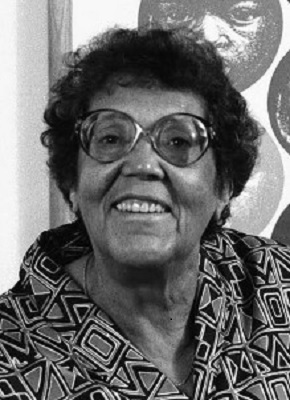
Elizabeth Catlett

April 15 …
Sculptor, printmaker, ardent feminist, and lifelong social activist, Elizabeth Catlett was a renown 20th century artist. For nearly 100 years — from Jim Crow segregation through the Cold War and into Barack Obama’s presidency — Catlett remained steadfast in her commitment to both her art and her political beliefs.
Born on April 15, 1915, Catlett was raised in segregated Washington, DC by parents proud of their heritage of resistance and survival. She regularly heard stories from grandparents who had survived enslavement, stories which shaped how she saw the world. As a teen she had demonstrated on the steps of the United States Supreme Court to protest the lynchings of Black Americans across the country.
Catlett was denied admission to Carnegie Mellon University because of race, despite presenting excellent entrance exams. She enrolled instead at Howard University, studying art under luminaries such as Loïs Mailou Jones and James Porter. Catlett went on to pursue a Master of Fine Arts degree at the University of Iowa, where she studied with artist Grant Wood.
Catlett excelled in printmaking, which due to its affordability, facilitated a wide distribution of her powerful images celebrating Black womanhood, labor dignity, and justice. Her prints were accessible in the community centers, schools, and homes of the people whose lives and struggles she so memorably portrayed.
From 1940 to 1942, Catlett chaired the art department of Dillard University, an HBCU in New Orleans. In 1946 she visited Mexico on a Julius Rosenwald Fellowship and joined the renowned Taller de Gráfica Popular (Peoples Graphic Workshop, or TGP) printmaking collective. TGP members believed in the power of art to educate and promote social change.
Catlett flourished in Mexico, meeting Mexican painter Francisco Mora, who she married in 1947. She broke barriers as the first woman to teach sculpture at the Universidad Nacional Autónoma de México, eventually heading the department. There, she developed her distinctive style, drawing upon modern, African, and Mesoamerican visual influences.
With the Rosenwald Fellowship, Catlett produced a series of 15 linocuts, originally called “The Negro Woman,” later retitled “The Black Woman.” Several depict famous Black women, including Sojourner Truth, Harriet Tubman, and Phillis Wheatley. The prints’ titles flow together to form a prose poem about the strength and suffering of Black women, contributing directly to the resistance movement against racial oppression.
Elizabeth Catlett’s advocacy for civil rights and workers’ rights cost her greatly. Constantly under surveillance by both the United States and Mexican governments, in 1962 the US government labeled her an “undesirable alien.” Claiming that the TGP was a “communist front,” it barred Catlett and all TGP artists from entering the United States.
For a decade, Catlett was repeatedly denied visas. Finally in 1971, American authorities allowed her to return to the United States for the opening of her solo show at the Studio Museum in Harlem. Her American citizenship was finally reinstated in 2002.
Elizabeth Catlett continued in her craft until her death at her studio home in Cuernavaca on April 2, 2012, at the age of 96. This extraordinary artist and lifelong activist, who believed in the power of art to promote social change, will be remembered for her myriad works celebrating human dignity and freedom.
Notes:
- “Who Is Elizabeth Catlett? 12 Things to Know,” National Gallery of Art May 15, 2025.
- Art Institute of Chicago. Member Lecture, Elizabeth Catlett.
- Wikipedia contributors, “Elizabeth Catlett,” Wikipedia, The Free Encyclopedia, (accessed July 10, 2025).