

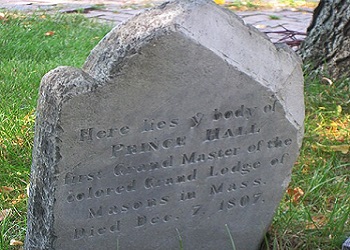
Prince Hall (Founder) founded what became known as Prince Hall Freemasonry, the oldest and most influential African American fraternal tradition in the United States. Born around 1735, possibly in Barbados or colonial New England, Hall was an abolitionist, educator, and Revolutionary War veteran. By the 1760s, he was living in Boston as a free Black man, working as a leather dresser and small-business owner. Hall also emerged as a civic and religious leader within Boston’s free African American community.
On March 6, 1775, Hall and 14 other free Black men were initiated into a military lodge affiliated with the British Army’s 38th Regiment of Foot, stationed in Boston. When the regiment departed the following year, the men received limited authorization to meet as a lodge but lacked authority to confer degrees or establish new lodges. Seeking formal recognition, Hall petitioned the Grand Lodge of England. On September 29, 1784, the Premier Grand Lodge of England issued a charter for African Lodge No. 459, with Prince Hall serving as Worshipful Master. This charter became the institutional foundation of Prince Hall Freemasonry in the United States.
Beyond his fraternal leadership, Hall vigorously advocated for Black education, abolition, and civil rights. He repeatedly petitioned the Massachusetts legislature in the 1770s and 1780s for the abolition of slavery and equal access to public schooling for Black children. In 1792, he helped establish one of Boston’s first schools for African American children, often using his own home or church facilities for instruction. Hall also publicly condemned the kidnapping of free Black people into slavery and urged moral reform, mutual aid, and racial uplift within the Black community.
Under Hall’s leadership, African Lodge became a center of religious, charitable, and political activity for free African Americans in the Northeast. After his death on December 4, 1807, Prince Hall Freemasonry expanded across the United States, the Caribbean, and parts of Africa, becoming one of the most significant institutions in African American civic life.
The legacy of Prince Hall (Founder) rests not only in the organization that bears his name, but also in his pioneering efforts to secure dignity, education, and institutional independence for Black Americans in the early republic.
Selected Sources:
- Grimshaw, William H. Official History of Freemasonry among the Colored People in North America. New York: Broadway Publishing Company, 1903.
- Wesley, Charles H. Prince Hall: Life and Legacy. Washington, DC: United Supreme Council, Ancient and Accepted Scottish Rite, Southern Jurisdiction, Prince Hall Affiliation, 1977.
- National Park Service. “Prince Hall.” Boston African American National Historic Site. U.S. Department of the Interior.
- “Prince Hall.” Encyclopaedia Britannica.