

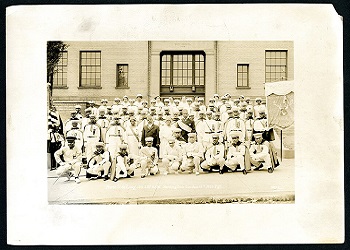
The Improved Benevolent and Protective Order of Elks of the World (IBPOEW) is one of the most prominent African American fraternal organizations in the United States, founded in the late 19th century in response to racial exclusion from white fraternal orders.
IBPOEW traces its origins to 1897 in Cincinnati, where Benjamin Franklin Howard and Arthur James Riggs led a group of Black men to establish a parallel organization after they were denied admission to the Benevolent and Protective Order of Elks. Adopting similar rituals and structures, it redirected its mission toward mutual aid, racial uplift, and community development within African American society.
The organization emerged during an era when segregation restricted Black Americans’ access to insurance, social services, and civic institutions. Like Prince Hall Freemasonry and other fraternal bodies, the IBPOEW offered sickness and death benefits and a framework for leadership and social cohesion.
Lodges, often called “Temples,” spread rapidly across urban centers such as Chicago, Detroit, and Philadelphia, where growing Black populations fueled their expansion. By the early 20th century, the Order had established a national structure governed by a Grand Lodge and had become a cornerstone of African American fraternal life.
During the early to mid-20th century, the IBPOEW flourished alongside the growth of Black urban communities, particularly during the Great Migration. Its lodges became central institutions in African American neighborhoods, serving as meeting places for civic organizations, sites of political organizing, and venues for charitable and educational initiatives.
In cities such as Washington and New York, Elks lodges often occupied substantial buildings that symbolized Black institutional permanence and economic achievement. These spaces also served as important cultural centers, regularly hosting concerts, dances, and touring performances by prominent African American entertainers, linking the Order to the broader development of Black cultural life in the 20th century. Through these activities, the lodges reinforced their role as hubs of community life, where social, economic, and cultural networks converged. Membership during this period grew into the hundreds of thousands, drawing from both working- and middle-class African Americans.
The IBPOEW also fostered leadership and civic engagement among its members. Founders such as Benjamin Franklin Howard and Arthur James Riggs were instrumental in shaping the organization’s early direction. Later leaders, including Fred C. Robinson and Hobson R. Reynolds, guided its national expansion in the 20th century. The Order’s programs emphasized education, youth development, and charitable work, reflecting its broader mission of racial uplift.
Like many fraternal organizations, the Improved Benevolent and Protective Order of Elks of the World saw membership decline in the latter half of the 20th century as social patterns shifted and alternative forms of civic engagement emerged. Nevertheless, it has remained active into the 21st century, maintaining lodges across the United States and continuing its emphasis on scholarship programs, health initiatives, and community service.
Selected Sources:
- Clawson, Mary Ann. Constructing Brotherhood: Class, Gender, and Fraternalism. Princeton: Princeton University Press, 1989.
- Williams, Joe M. “The Role of Black Fraternal Organizations in Economic Development.” Journal of African American History 90, no. 1–2 (2005): 1–20.