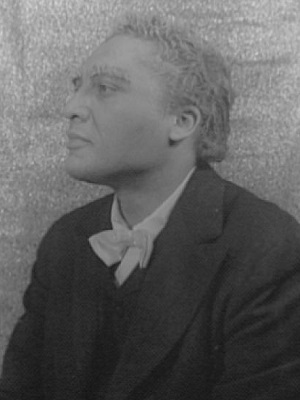
William Marshall

August 19 …
William Marshall was an actor, director, writer, opera singer, and educator whose unusually broad career connected Shakespearean theater, Broadway, opera, television, Black historical drama, popular film, and children’s entertainment.
Listen to this story:
Born August 19, 1924 in Gary, IN, Marshall initially studied art at New York University before turning toward acting and receiving training at the Actors Studio, American Theatre Wing, and Neighborhood Playhouse, where he studied under influential acting teacher Sanford Meisner. His professional theater career began with his 1944 Broadway debut in “Carmen Jones.” He subsequently appeared in “Peter Pan” as an understudy for Boris Karloff’s Captain Hook, and played De Lawd in the 1951 Broadway revival of “The Green Pastures.”
Marshall’s classical training, imposing 6-foot-5-inch presence, and exceptionally deep bass voice made him particularly suited to Shakespeare and serious drama. His portrayal of Othello became the centerpiece of his theatrical reputation. He performed the role repeatedly in the United States and Europe, and the London Sunday Times famously described him as “the best Othello of our time.”
Marshall’s theatrical contemporaries included such major performers as Paul Robeson, Sidney Portier, Ossie Davis, and Canada Lee, while his artistic lineage was strongly connected to Robeson’s pioneering work in Shakespeare and Black theater. He was dedicated to portraying historical figures, including Frederick Douglass, demonstrating that he regarded performance as a means of preserving and interpreting Black history rather than simply entertainment. He also portrayed Robeson, linking his own career to a predecessor who had demonstrated that an African American actor could combine classical theater, music, intellectual achievement, and social activism.
Marshall’s film and television career developed alongside his stage achievements, although Hollywood offered him fewer substantial roles than his talent warranted. He made his film debut in Lydia Bailey, and subsequently appeared in other productions including Demetrius and the Gladiators and The Boston Strangler. He also became a familiar television performer through programs such as Bonanza, The Wild Wild West, and Star Trek.
Marshall’s greatest popular-film recognition came with Blacula and Scream Blacula Scream. He pushed for the character to be transformed from a stereotypical, foolish Black character into a dignified African prince who had opposed the slave trade before being transformed into a vampire. That decision fundamentally changed the character’s cultural meaning and allowed Marshall to bring his Shakespearean authority to a genre film. Blacula consequently became an important example of how Black filmmakers and performers could appropriate familiar Hollywood genres and reshape them around African American identity and historical consciousness.
Marshall’s contributions extended deeply into music, education, and the preservation of Black cultural history. He possessed formal training and experience in grand opera, and he also created and performed in theatrical works drawing upon the writings of Shakespeare, Walt Whitman, Richard Wright, and Billy Strayhorn.
Marshall’s educational influence was equally important. He taught acting at institutions including the University of California, Irvine and Chicago’s ETA Creative Arts Foundation. These activities made him a mentor and teacher to emerging performers.
Younger audiences of the 1980s know Marshall as the King of Cartoons on Pee-wee’s Playhouse, a role he accepted partly because of his grandchildren. Although he became internationally recognized as Othello and popularly remembered as the title character of Blacula, his larger contribution was his insistence that Black performers could portray figures of dignity, intellect, authority, historical importance, and romantic power at a time when American entertainment routinely restricted African American actors to stereotyped roles.
Marshall was among the inaugural honorees of the Black Filmmakers Hall of Fame, and his two Emmy Awards remain among his most clearly documented competitive honors. His work as Frederick Douglass, Paul Robeson, and Othello reflected an enduring commitment to Black history, while his Blacula performance helped establish a memorable Black presence in American horror cinema.
Marshall died June 11, 2003 in Los Angeles at age 78. His funeral was attended by prominent colleagues, including Sidney Poitier, Ivan Dixon, Paul Winfield, and Marla Gibbs.
Marshall’s legacy rests on the remarkable breadth of his artistic life and his refusal to separate entertainment from Black cultural representation. His career crossed Broadway, classical theater, opera, Hollywood, television, public broadcasting, and community arts, allowing different generations to encounter him in very different forms.
William Marshall was a classically trained actor who used Shakespeare, opera, historical drama, television, popular horror, and education to challenge the narrow boundaries imposed on African American performers. In doing so, he helped expand ideas about who could occupy the center of the stage and screen — and what stories, histories, and cultural identities could command that space.