

July 4 …
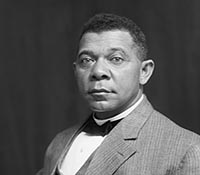
Booker T. Washington founded Tuskegee University — a private, historically Black land-grant institution in Tuskegee, AL — on July 4, 1881.
Originally the Tuskegee Normal School for Colored Teachers, its founding reflected the urgent need for Black educators in the post-Reconstruction South.
Under Washington’s leadership, Tuskegee developed a curriculum rooted in industrial education, emphasizing agriculture, mechanical trades, and domestic sciences as pathways to economic independence. His emphasis on industrial education and his public accommodation to white Southern power structures were viewed by critics — most notably W.E.B. DuBois — as concessions to white supremacist demands that Black education remain limited in scope. Washington often avoided direct public challenges to segregation, arguing that economic progress would lay the groundwork for eventual equality.
Over time, however, Tuskegee Institute expanded beyond vocational training into a comprehensive university. By the early 20th century, it offered collegiate instruction, later adding graduate programs, and in 1985 it officially became Tuskegee University.
Today, It is especially known for strong programs in engineering, animal and poultry sciences, nursing, business, and its highly regarded College of Veterinary Medicine — one of the few such programs at a historically Black institution.
Tuskegee has awarded tens of thousands of degrees since its founding, and its veterinary school — established in 1945 — has produced more than 70 percent of the nation’s African American veterinarians and over 7,000 veterinary medical graduates. This makes the university one of the most significant contributors to diversity in the profession.
Tuskegee has produced influential alumni across multiple fields whose accomplishments reflect the university’s evolution into a center of academic excellence across disciplines. Among them are:
- Ralph Ellison (1936) — Author of Invisible Man.
- Lionel Richie (1974) — Globally renowned singer-songwriter.
- Betty Shabazz (1953) — Prominent educator and widow of Malcolm X.
- Tom Joyner (1975) — Influential media personality.
Today, Tuskegee University stands as a major institution in American higher education and African American history. Its legacy reflects both the strategic compromises and enduring aspirations that shaped Black education, while its academic programs continue to prepare students for leadership in science, medicine, business, and the arts.
Selected Sources:
- Louis R. Harlan, Booker T. Washington: The Wizard of Tuskegee, 1901–1915 (New York: Oxford University Press, 1983).
- W.E.B. Du Bois, The Souls of Black Folk (Chicago: A.C. McClurg & Co., 1903).
- Robert J. Norrell, Up from History: The Life of Booker T. Washington (Cambridge, MA: Belknap Press of Harvard University Press, 2009).
- James D. Anderson, The Education of Blacks in the South, 1860–1935 (Chapel Hill: University of North Carolina Press, 1988).