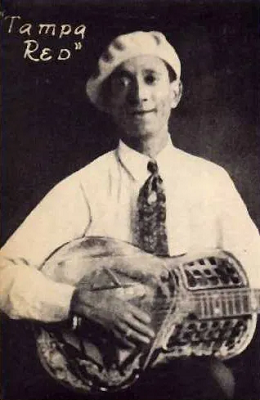
Tampa Red
January 8
Tampa Red — also known as “The Guitar Wizard” — was one of the most vibrant and influential figures in early American blues, a musician whose work helped shape not only the sound of the blues but the broader currents of American popular music in the twentieth century.
Born Hudson Woodbridge — aka Hudson Whittaker — on Jaunary 8, 1903 in Smithville, GA and raised in Tampa, FL, he took his musician’s name from the city that helped form his early identity and from the reddish hue of his hair.
As a young guitarist, he was captivated by the rhythms and expressive potential of the blues, learning his initial licks from a street musician named Piccolo Pete and from the country blues and hokum recordings of the 1920s. These formative experiences ignited his passion for the guitar and steered him toward becoming one of the genre’s most innovative figures.
In the mid-1920s, Red moved to Chicago, where the burgeoning urban blues scene presented opportunities unavailable in the rural South. His big break arrived when he was hired to accompany the legendary blues singer Ma Rainey, a role that introduced him to pianist and composer Thomas A. Dorsey — then known as Georgia Tom. Together, they recorded the lively hit “It’s Tight Like That” in 1928, a track that sold millions and helped popularize the “hokum” style of blues with its witty, risqué lyrics and upbeat rhythms. This collaboration not only expanded Tampa Red’s audience but also allowed him to develop his distinctive slide guitar technique and songwriting voice.
Red’s most significant contribution to American music was his pioneering slide guitar work. He was the first Black musician to adopt a steel-bodied National resonator guitar, an instrument well-suited for the pre-amplification era due to its bright, penetrating tone. He perfected a smooth, single-string bottleneck style that stood in contrast to the chord-heavy slide playing prevalent at the time. This technique, emphasizing melodic runs and expressive glissandos, not only defined his unique sound but also became a model for later Chicago blues artists and electric blues guitarists. Musicians such as Muddy Waters, Elmore James, and Robert Nighthawk built upon Tampa Red’s innovations, with many twentieth-century blues and rock guitarists acknowledging his influence on their work.
Throughout the 1930s and ’40s, Red was a central figure in Chicago’s music scene as both a leader and collaborator. After his partnership with Dorsey ended, he became a sought-after session musician, contributing to recordings by artists like Sonny Boy Williamson, Memphis Minnie, and Big Maceo Merriweather. He also formed the Chicago Five, a group of session musicians whose work for Victor and Bluebird Records helped define the small-group urban blues sound that would later influence jump blues and early rock and roll. Beyond the studio, his home served as an informal hub for blues musicians arriving in Chicago during the Great Migration, offering rehearsal space, bookings, and support to younger players navigating a competitive environment.
Although his first recording did not have much success — it was the B-side to “How Long How Long” by Blind Lemon Jefferson (Paramount’s biggest star at the time) — Tampa Red’s recording legacy was remarkable. Over a career spanning more than three decades, he recorded hundreds of tracks, producing more 78-rpm sides than almost any other blues artist of his era, and composed songs that became standards in the blues canon.
Tracks like “It Hurts Me Too,” “Love Her with a Feeling,” “Black Angel Blues,” and “Let Me Play With Your Poodle” achieved chart success in the 1940s and continued to resonate through cover versions from later artists across various genres. Although formal accolades were scarce for blues musicians of his generation, he was posthumously inducted into the Blues Foundation Hall of Fame, recognizing the profound and lasting impact of his music.
While Red did not establish a formal group of protégés, his influence resonated through generations of guitarists, from Chicago blues stalwarts to rock and blues revivalists in the 1960s and beyond. Muddy Waters, B.B. King, Chuck Berry, the Allman Brothers, and Eric Clapton all drew from stylistic elements rooted in his slide technique and songwriting prowess. Thus, his creative legacy transcends his recordings, shaping the evolution of American music and the role of the electric guitar within it.
The life story of Tampa Red — from Southern roots to Chicago blues prominence — reflects not only the migration and transformation of a musical form but also the broader cultural journey of African American artistry in the 20th century.