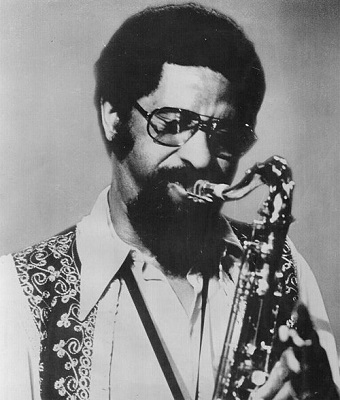
Sonny Rollins
September 7 …
Sonny Rollins was a towering tenor saxophonist and composer whose improvisational mastery and original compositions helped define and expand modern jazz over a seven-decade career.
Listen to this story:
Born Walter Theodore Rollins on September 7, 1930 in New York City to parents from the Virgin Islands, he was raised in Harlem and Sugar Hill, receiving his first alto saxophone as a child before transitioning to tenor by his mid-teens. He attended Benjamin Franklin High School and played in early bands alongside notable musicians such as Jackie McLean, Kenny Drew, and Art Taylor.
Rollins’ early mentors included Thelonious Monk, who provided both musical guidance and collaborative opportunities, while Coleman Hawkins became his initial idol on the tenor saxophone. He also drew inspiration and lessons from Bud Powell, Charlie Parker, and the vibrant local bebop scene.
Rollins boasted an impressive discography, with over 60 albums as a leader and a series of landmark recordings that include Saxophone Colossus, Tenor Madness (featuring John Coltrane), Way Out West, Freedom Suite, and A Night at the Village Vanguard. His compositions, such as “St. Thomas,” “Oleo,” “Doxy,” and “Airegin,” have become enduring standards.
A pioneer of extended unaccompanied improvisation and calypso-inflected grooves in jazz, Rollins also introduced large-scale thematic development within his solos. His 1959–61 sabbatical on the Williamsburg Bridge and his studies in India reflect his rigorous self-discipline and spiritual pursuits.
Among Rollins’ contemporaries and collaborators were Miles Davis, Max Roach, Clifford Brown, John Coltrane (notably on Tenor Madness), Thelonious Monk, and Jackie McLean. Younger musicians such as Tommy Flanagan, Bob Cranshaw, Jack DeJohnette, and George Cables cited him as a foundational influence, while many later saxophonists, including Wayne Shorter and Branford Marsalis, recognize his impact.
Rollins’ honors included being elected to the DownBeat Jazz Hall of Fame in 1973 and named an NEA Jazz Master in 1983. He received multiple Grammys, including a Lifetime Achievement Award in 2004, Polar Music Prize in 2007, National Medal of Arts in 2010, and Kennedy Center Honors in 2011, along with numerous honorary doctorates and international awards.
Rollins’ cultural and historical influence transcended his recordings. He played a pivotal role in utilizing jazz as a medium for personal and political expression, as exemplified by Freedom Suite — a significant early hard-bop civil rights statement.
Rollins’ modeling of artistic self-renewal through sabbaticals and spiritual exploration, along with his incorporation of Caribbean and world influences, broadened jazz’s rhythmic diversity and brought improvisational thinking into a wider American context.
Sonny Rollins was the last surviving artist to appear in the famous photograph, A Great Day In Harlem, when he died on May 25, 2026 at age 95. His longevity and distinctive improvisational voice solidified his status as one of the central figures in 20th-century American music.