


SNCC


April 15 …
The Student Nonviolent Coordinating Committee (SNCC) and later, the “Student National Coordinating Committee,” pronounced “snick,” was founded on April 15, 1960 in Raleigh, NC at a meeting organized by civil rights leader Ella Baker at Shaw University.
Initially formed to support and organize student-led sit-ins against segregated lunch counters, the organization quickly grew into one of the most influential organizations of the Civil Rights Movement. It attracted young activists from across the country who were committed to using nonviolent direct action to confront racial injustice in the South.
The organization played a central role in many of the major civil rights campaigns of the 1960s. Its members helped organize Freedom Rides to challenge segregation on interstate buses, participated in voter registration drives in hostile Southern counties, and were key figures in the 1963 March On Washington.
Workers risked their lives daily, often facing arrests, beatings, and violence from white supremacists and police. Despite these dangers, their courage and determination helped bring national attention to the brutal realities of segregation and racism in America.
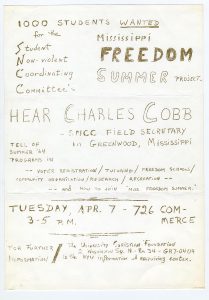
Poster of 1000 Students Wanted For The Mississippi Freedom Summer Project (photo from the Mississippi Department of Archives and History)
Over time, the organization evolved in its philosophy and strategy. While it was originally rooted in Christian nonviolence, by the mid-1960s the group began to question whether nonviolence was sufficient to bring about real change. Influenced by leaders like Stokely Carmichael, it embraced the concept of the Black Power Movement, advocating for racial pride, self-determination, and political and economic empowerment for African Americans. This shift led to tensions with other civil rights organizations and the eventual loss of some mainstream support, but it also marked a powerful new phase in the Black Liberation Movement.
Though the organization disbanded by the early 1970s, its legacy continues to influence modern social justice movements. It was instrumental in shifting the civil rights movement toward grassroots activism and youth leadership.
SNCC empowered a generation of young Black Americans to take bold, direct action against injustice and laid the groundwork for ongoing struggles for voting rights, racial equality, and community control. Its history stands as a powerful reminder of what can be accomplished when courage, vision, and grassroots organizing come together in pursuit of justice.
