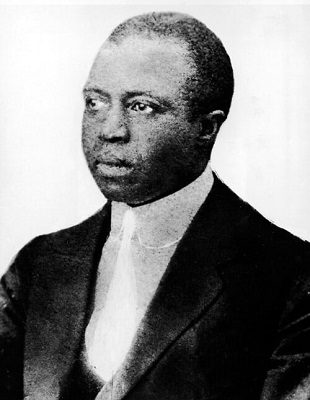
Scott Joplin
November 24
Scott Joplin — often hailed as the “King of Ragtime” — was a pioneering African American composer and pianist whose influence shaped the trajectory of American music at the turn of the 20th century.
Born in Texas on November 24, 1868, Joplin grew up in a musical family that valued creativity and self-expression despite the racial and economic constraints of post-Civil War America. His early exposure to both classical music and African American folk traditions laid the foundation for his innovative compositions, which would soon take the country by storm.
Joplin’s signature contribution was the development and popularization of ragtime, a genre characterized by its syncopated rhythms and lively melodies. Unlike earlier dance music, Joplin’s rags exhibited a formal structure and musical sophistication that elevated them from simple entertainment to art. His breakthrough came in 1899 with the publication of Maple Leaf Rag, a piece that became a massive commercial success and one of the most influential works in American popular music. It was this composition that not only brought Joplin fame but also introduced ragtime to a national audience.
Through ragtime, Joplin blended African rhythmic sensibilities with European classical forms, creating a distinctly American sound that laid the groundwork for jazz. His music reflected the complexities of Black life in a segregated society, celebrating joy and resilience while subtly challenging racial stereotypes. At a time when Black musicians were often limited to performing rather than composing, Joplin insisted on being recognized as a serious composer, and he fiercely protected the integrity of his work.
Joplin’s ambitions went beyond ragtime piano pieces. He composed two operas, A Guest of Honor and Treemonisha, the latter of which is considered a landmark in American opera. Treemonisha, completed in 1911, told the story of a young Black woman who leads her community out of ignorance through education and empowerment. Though it was not fully staged during his lifetime, the opera demonstrated Joplin’s deep commitment to advancing African American cultural identity and confronting the legacies of slavery through music.
Despite his achievements, Joplin struggled financially and professionally in his later years. He faced persistent racism in the music publishing industry and often saw his work appropriated or dismissed. The lack of institutional support and the stress of his unrelenting efforts took a toll on his health.
Scott Joplin died in 1917 from complications related to syphilis, largely unrecognized by the musical establishment of his time. Yet his vision endured, and his music never truly faded from public consciousness.
In the 1970s, a major revival of interest in ragtime music brought Joplin posthumous acclaim. The use of The Entertainer in the film The Sting (1973) reintroduced his work to new generations and helped cement his legacy in American culture. In 1976, he was awarded a Pulitzer Prize posthumously, acknowledging his profound contributions to American music. This recognition affirmed Joplin’s role not only as a musician but as a cultural icon who helped define a uniquely American art form.
Joplin’s life and work stand as a testament to the power of creativity in the face of adversity. He broke artistic and racial barriers, using music to express the struggles and aspirations of Black Americans during a time of profound social inequity.
The influence of Scott Joplin on jazz, classical music, and American popular culture is immeasurable. Today, he is celebrated not only as a master of ragtime, but as a visionary who transformed the American musical landscape forever.