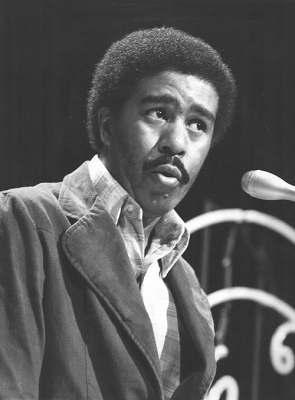
Richard Pryor

December 1 …
Richard Pryor was a revolutionary stand-up comedian, writer, and actor whose raw, autobiographical humor and fearless confrontation of race, addiction, and American life redefined modern comedy and left a lasting mark on entertainment and culture.
Born on December 1, 1940 in Peoria, IL, Pryor faced a challenging childhood — growing up in his grandmother’s brothel, abandoned by his mother, and experiencing abuse — transforming these traumas into the heart of his artistry. He left school at a young age, had a brief stint in the U.S. Army, and honed his performance skills on the stages of Peoria, Cleveland, and eventually New York and Los Angeles, forgoing formal academic training.
Pryor’s remarkable achievements include multiple Grammy Awards for his comedy albums, an Emmy for writing on Lily Tomlin’s television special, significant film roles in Silver Streak, Stir Crazy, and Lady Sings the Blues, as well as the autobiographical film Jo Jo Dancer, Your Life Is Calling.
In 1998, Pryor received the inaugural Mark Twain Prize for American Humor. His concert film Richard Pryor: Live on the Sunset Strip and his groundbreaking albums pioneered a new, confessional style of stand-up that reshaped record sales, concert filmmaking, and the commercial success of bold, socially conscious comedy.
Artistically, Pryor blended influences from earlier comedians like Lenny Bruce, Redd Foxx, and Dick Gregory with cinematic storytelling. He collaborated with — and was informally mentored by — peers and writers in television and film, co-writing Blazing Saddles with Mel Brooks and working alongside Lily Tomlin early in his career.
Pryor’s contemporaries and colleagues included George Carlin, Paul Mooney, Gene Wilder, and Whoopi Goldberg, all of whom have acknowledged his influence and participated in tributes. His unique style and subject matter inspired a lineage of protégés and admirers. Comedians such as Eddie Murphy, Chris Rock, Dave Chappelle, and Richard Lewis consider him a direct influence. His idols and peers spanned both black and white comic traditions, demonstrating the breadth of his impact.
Pryor’s accolades reflect his artistic contributions and cultural significance: five Grammy Awards for comedy recordings, an Emmy for writing, the 1998 Mark Twain Prize for American Humor, posthumous recognition with a Grammy Lifetime Achievement Award, a star on the Hollywood Walk of Fame, and numerous lifetime achievement honors.
Beyond the awards, the legacy of Richard Pryor is evident in how stand-up comedy evolved into a powerful vehicle for candid social critique. He influenced subsequent generations who emulate his confessional realism — and in American culture’s more open dialogue about race, class, addiction, and personal trauma through comedy.