
April 4 …
Paul Quinn College (PQC) in Dallas, TX — affiliated with the African Methodist Episcopal Church (AME) — is the state’s oldest historically Black college, the oldest HBCU west of the Mississippi, and the nation’s first urban work college.
Listen to this story:
The college was established on April 4, 1872, when AME ministers founded the Connectional School for the Education of Negro Youth in the basement of Metropolitan AME Church in Austin. The college aimed to educate formerly-enslaved African Americans and to prepare teachers, ministers, and community leaders in the challenging post-Civil War era.
In 1877, the school relocated to Waco and became Waco College. The move provided larger facilities and allowed the school to expand its curriculum beyond the elementary level.
In 1881, the State of Texas issued a charter. It renamed the institution Paul Quinn College, honoring Bishop William Paul Quinn, the fourth bishop of the African Methodist Episcopal Church and a key supporter of Black education across the Midwest and South. In the late 1800s and early 1900s, the college combined industrial training with the liberal arts, preparing students for roles as teachers, ministers, business leaders, and tradespeople while promoting racial uplift and economic independence.
Like many private Black colleges, Paul Quinn experienced heavy financial difficulties during the Great Depression. Under President A.J. Jackson, the college reduced its debt, improved facilities, and gained accreditation from the Texas Department of Education in 1938, which helped sustain it through one of its hardest times.
After desegregation broadened educational access, enrollment dropped, leading to another major change. In 1990, Paul Quinn moved from Waco to Dallas, taking over the former Bishop College campus after its closure. This relocation placed the college in a large metropolitan area, creating new chances for partnerships with local businesses, civic groups, and the community.
Under President Michael Sorrell, who assumed leadership in 2007, the college entered a new chapter. Confronted with declining enrollment and financial hurdles, Sorrell spearheaded extensive reforms that elevated Paul Quinn into one of the most innovative HBCUs in the country.
In 2015, it earned the distinction of being America’s first Urban Work College, where all residential students are required to engage in paid internships or work experiences to reduce their student debt and gain real-world skills. Additionally, the college attracted national recognition by transforming its former football field into the “WE Over Me Farm,” an urban agricultural initiative that tackles food insecurity and offers hands-on learning opportunities.
Today, Paul Quinn has around 550 students and offers bachelor’s degrees in business administration, entrepreneurship, communications, history, mathematics, psychology, political science, and teacher education. It also offers a Master of Business Administration.
The curriculum focuses on leadership, entrepreneurship, civic engagement, and workforce readiness, embodying its Urban Work College model. This approach aligns with the school’s mission to eliminate intergenerational poverty through education and meaningful employment.
Paul Quinn College’s alumni have distinguished themselves in various fields, including public service, business, education, sports, and community leadership. Prominent graduates include the following individuals.
- Mims Hackett (1969) — Former member of the New Jersey General Assembly;
- Hiawatha Williams (1972) — Founder of Williams Chicken restaurants;
- Toni Rose (1993) — Member of the Texas House of Representatives; and
- Kevin Kelley (2000) — CEO of the Dallas Citizens Council.
These notable graduates, along with many educators, ministers, entrepreneurs, and civic leaders, exemplify Paul Quinn College’s commitment to leadership, service, and economic development.
Over 150 years after its founding, Paul Quinn College remains committed to its founders’ vision by integrating Christian principles, academic achievement, hands-on work experience, and community involvement to equip students to be catalysts for social and economic transformation.
About The Photo:
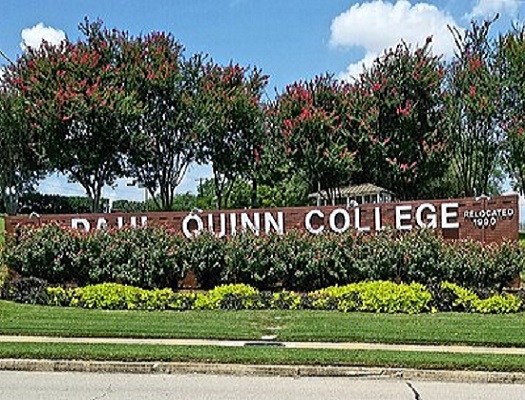
- Paul Quinn College entrance sign photography is by Broadmoor.
Selected Sources:
- Hales, Douglas. Paul Quinn College. Handbook of Texas Online. Texas State Historical Association. Originally published 1976; revised September 24, 2020.
- Heintze, Michael R. Private Black Colleges in Texas, 1865–1954. College Station: Texas A&M University Press, 1985.
- Kaul, Abhinav. Paul Quinn College (1872– ). BlackPast.
- Nelson, Brandice. “Paul Quinn College.” Waco History. Baylor University Institute for Oral History. Texas Historical Commission.
- Paul Quinn College. Mission, Vision & History. Dallas: Paul Quinn College.