
Obama Presidential Center


June 18 …
The Obama Presidential Center — officially dedicated on June 18, 2026 and opened to the public the next day — stands in Chicago’s historic Jackson Park as a monument to Barack Obama’s presidency, the nation’s first African American president.
Listen to this story:
Located on Chicago’s South Side, near the Hyde Park and Woodlawn neighborhoods, the approximately 19.3-acre, $850 million complex marks a departure from traditional presidential libraries. Barack and Michelle Obama conceived it as both a historical institution and a center for civic engagement, celebrating their personal journeys while encouraging future generations to help strengthen American democracy. Its location reflects the couple’s deep ties to Chicago, where Michelle Obama grew up and Barack Obama began his political career as a community organizer.
Planning for the Obama Foundation began with its founding in January 2014. After weighing competing locations, the foundation chose Chicago’s South Side and unveiled its architectural vision in May 2017.
The Obamas envisioned more than a museum that preserves presidential accomplishments. They wanted a living institution that would inspire public service, develop young leaders, and encourage ordinary citizens to become agents of change. This philosophy drew on Obama’s experience organizing communities in Chicago and his belief that meaningful social progress comes through collective action. However, the center’s development sparked controversy.
Preservationists opposed construction in historic Jackson Park, originally designed by Frederick Law Olmsted and Calvert Vaux. Neighborhood organizations also raised concerns about rising property values, displacement, and whether nearby residents would share in the anticipated economic benefits. Legal challenges and extensive planning reviews delayed construction, which officially began on September 28, 2021.
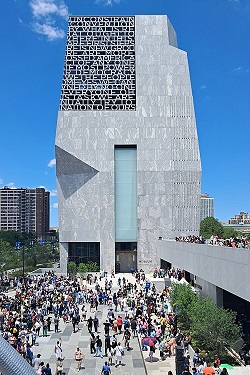
Obama Center’s museum tower and John Lewis Plaza on June 2026 opening day.
Architects Tod Williams and Billie Tsien designed the center around accessibility, community participation, and collective achievement. Its most distinctive feature is a 225-foot granite-clad museum tower, sculpted to evoke four hands coming together as a symbol of cooperation and shared responsibility. The building’s imposing appearance has drawn both admiration and criticism. The architects, however, said the tower should reflect the significance of Obama’s presidency while prompting visitors to consider their own responsibilities as citizens.
On the upper level, the Nelson Mandela Sky Room offers panoramic views of Chicago’s South Side and Lake Michigan. The surrounding campus includes a public plaza, auditorium, classrooms, a Chicago Public Library branch, gardens, walking paths, and Home Court, a recreational and athletic facility. Much of the campus is accessible without admission, reinforcing its intended role as a community gathering place.
The museum places Obama’s life and presidency within the broader history of American democracy and African American struggles for equality. Its exhibitions follow his childhood in Hawaii, education, community organizing, historic 2008 election, and two presidential terms. Rather than presenting his achievements in isolation, the galleries highlight the generations of activists, reformers, and ordinary Americans whose efforts helped make his presidency possible.
Exhibits explore slavery, emancipation, women’s suffrage, and the Civil Rights Movement, framing democracy as an unfinished national undertaking. The center also differs from conventional presidential libraries: Obama’s presidential records remain in the custody of the National Archives and Records Administration, which operates a separate presidential library based predominantly on a digital model. Public art supports the institution’s cultural mission, with commissioned works by prominent artists including Julie Mehretu, Mark Bradford, Carrie Mae Weems, and others.
The center’s opening was deliberately timed to coincide with Juneteenth, the national commemoration of emancipation. A June 18 dedication ceremony brought together Barack and Michelle Obama, civic leaders, and artists and entertainers, including Stevie Wonder, Jennifer Hudson, John Legend, and Bruce Springsteen. Public celebrations continued through June 21, drawing thousands of visitors to the South Side.
The opening marked both the culmination of more than a decade of planning and the start of an experiment in presidential commemoration. Its ultimate success will depend not only on visitor numbers or architectural distinction, but also on whether it fulfills its promise to strengthen surrounding communities and inspire sustained civic participation.
As an institution honoring the first Black presidency, the Obama Presidential Center links African American historical achievement to a broader vision of democratic citizenship. It presents Barack Obama’s legacy not as a closed chapter, but as an invitation to future generations.
Selected Sources:
- Glusac, Elaine. “Here’s How the Obama Presidential Center Is Different From Other Presidents’ Museums.” Smithsonian Magazine, June 18, 2026.
- Keegan, Edward. “Barack Obama Was the Shadow Architect of a Chicago-Style Treasure Box Museum.” Chicago Tribune, June 7, 2026.
- Bey, Lee. “Obama Center and Its Maligned Signature Building Are Worthy of Consideration.” Chicago Sun-Times, June 2026.
- Steinberg, Neil. “Like the Obama Presidential Center, Jackson Park Was Born Over the Furious Objections of Chicagoans.” Chicago Sun-Times, June 12, 2026.
- Obama Foundation. “President and Mrs. Obama Announce Conceptual Vision for Design of Obama Presidential Center.” May 3, 2017.
- Obama Foundation. “New Renderings for Obama Presidential Center Feature Updates to Museum Building and New Children’s Playground.” 2019.
- Obama Foundation. “Grand Opening.” June 18–21, 2026.
- National Archives and Records Administration. “Updated Information About Obama Presidential Library.” National Archives, n.d.