

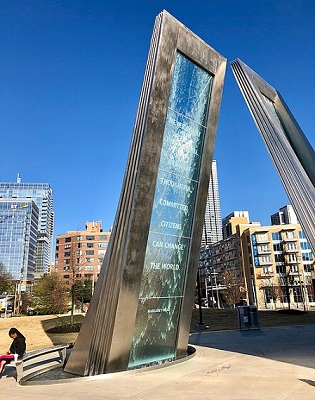
National Center for Civil and Human Rights


June 23 …
The National Center for Civil and Human Rights in Atlanta is a major cultural institution that connects the history of the Civil Rights Movement with contemporary global human rights struggles.
The Center opened its doors to the public on June 23, 2014 after over a decade of meticulous planning, with its roots tracing back to discussions that began in 2001 and formal development efforts between 2005 and 2007. Key visionaries — like Evelyn Lowery, Andrew Young, Juanita Abernathy, and John Lewis — initially conceived the idea, aiming to create a space that would celebrate Atlanta’s pivotal role in the Civil Rights Movement.
Former Atlanta mayor Shirley Franklin played a crucial role in actualizing the concept, while corporate and philanthropic partners — including The Coca-Cola Company, which donated the land — and notable donors like Arthur Blank, provided vital financial support. Construction kicked off in 2012 after facing delays due to the Great Recession, and the project was ultimately realized as a dedicated museum in the Pemberton Place district of downtown Atlanta.
From the beginning, the Center has aimed to inspire visitors to engage with critical issues of justice, equality, and human dignity by connecting historical narratives to contemporary activism. Its exhibitions prominently feature original documents from Martin Luther King Jr., immersive experiences like sit-in simulations, and global human rights case studies, highlighting the ongoing relevance of past struggles to today’s social justice movements.
The Center also serves as an educational and advocacy hub, offering training programs for students, nonprofit leaders, and law enforcement, as well as initiatives focused on diversity, equity, and inclusion. In 2022, it was officially incorporated into the African American Civil Rights Network, underscoring its national historical importance and aligning it with broader preservation and education efforts.
The Center attracts a diverse range of visitors, including students, educators, tourists, scholars, and community advocates, reflecting its dual role as both a museum and a civic space. It is consistently recognized as one of Atlanta’s key cultural attractions, drawing significant numbers of local and international visitors interested in civil rights history.
The Center’s influence extends beyond in-person visits through digital education programs, public events, and leadership initiatives that engage thousands more participants. It also has garnered acclaim for its contributions to public history and social engagement, receiving recognition within the African American Civil Rights Network and praise for its immersive storytelling techniques.
Continued investment — including a major expansion totaling over $50 million completed in 2025 — highlights the evolving mission of the National Center for Civil and Human Rights as a leading institution shaping national dialogues on civil rights, democracy, and social justice in the United States.
